
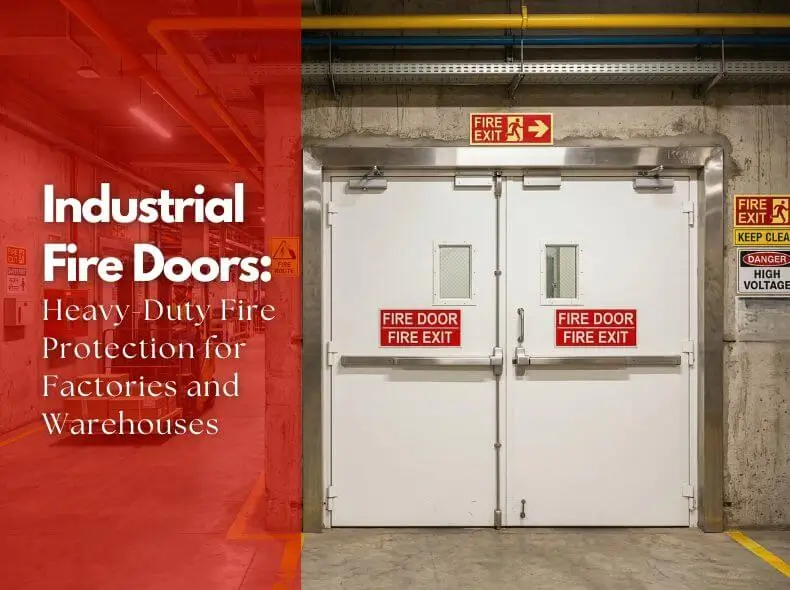
Heavy-duty industrial fire doors play a silent but decisive role in whether a factory or warehouse incident stays a controllable event or turns into a catastrophic loss of life, assets, and productivity. In high-risk environments with flammable materials, heavy machinery, and 24×7 operations, choosing the right door is no longer a “good-to-have” but a compliance and business continuity necessity.
What Makes Industrial Fire Doors Different?
Industrial fire doors are engineered to compartmentalise fire, smoke, and heat between production zones, storage areas, and escape routes in factories and warehouses. Unlike regular doors, they are designed, tested, and certified to withstand fire for a defined time-commonly 60, 90, or 120 minutes-while maintaining structural integrity and allowing safe evacuation.
Key differences from ordinary doors include:
- Tested as per fire resistance standards like IS 3614:2021, BS 476, or EN 1634-1.
- Use of robust steel construction with fire-resistant infill materials and intumescent seals.
- Mandatory labeling, certification, and installation as per national codes and BIS guidelines.
For Indian industrial users, compliant industrial fire doors are now directly linked to regulatory approvals, insurance, and long-term risk management.
Regulatory Landscape for Indian Industries (2025–2026)
Indian regulations around fire safety and industrial fire doors have become significantly stricter in recent years. For factories and warehouses, this has direct implications for procurement, installation, and periodic audits.
Core Standards and Codes
- IS 3614:2021 – Fire Doors and Doorsets – Specification
This is the primary Indian Standard defining design, construction, materials, installation, and performance requirements for fire doors and doorsets. It covers steel fire doors, wooden, and composite doors with ratings based on fire-resistance duration, focusing on integrity, insulation, and smoke control. - National Building Code (NBC) 2016 (and amendments)
NBC mandates that fire doors used in commercial, industrial, and high-rise buildings comply with IS 3614 for fire safety approvals and occupancy certificates. - Draft BIS Quality Control Order (QCO) 2025 for Steel Doors, Windows, Ventilators and Fittings
The draft Quality Control Order 2025 proposes that steel doors, including steel fire doors, must conform to IS 3614:2021 and carry BIS certification for sale in India. This will make third-party certification effectively mandatory for industrial fire doors used in factories and warehouses. - BIS Certification (ISI Mark) Requirement
BIS certification under IS 3614:2021 is mandatory for fire doors and doorsets, ensuring safety, durability, and performance. ISI-marked doors confirm that the product has undergone testing, audits, and quality control as per the standard.
For plant heads and EHS managers, this means that industrial fire doors are no longer a “general hardware” purchase-they must be fully compliant, certified, and traceable products.
Essential Features of Heavy-Duty Industrial Fire Doors
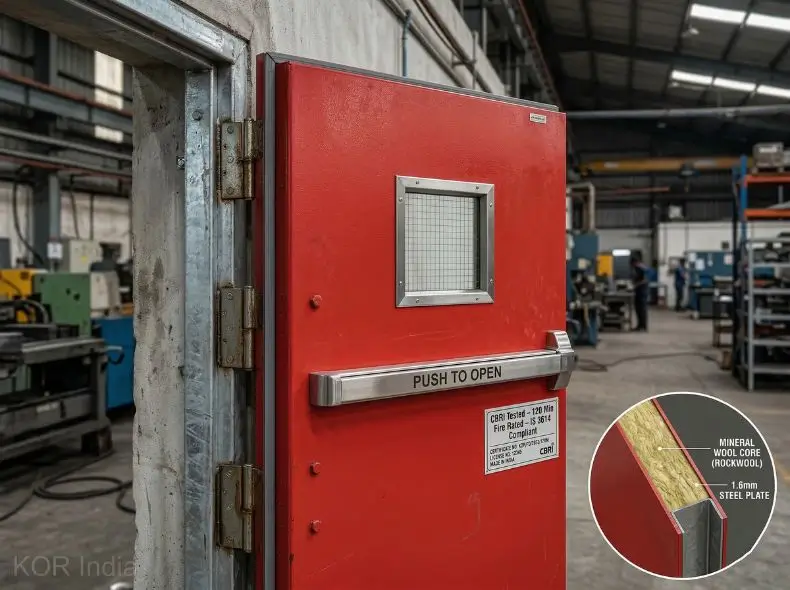
1. Certified Fire Rating (60, 90, 120 Minutes)
The fire-resistance rating determines how long a door can resist fire exposure while maintaining structural integrity and limiting heat transfer. In industrial settings, 60-minute doors may be used for low-risk areas, while 90- or 120-minute doors are preferred for high-risk zones like chemical stores, paint shops, or transformer rooms.
A compliant fire door should:
- Be tested in accredited labs as per IS 3614:2021, IS 3614 Part 2, BS 476, or EN 1634-1.
- Offer proven stability and integrity for the specified duration (e.g., 120 minutes).
- Have the rating clearly mentioned on labels and test certificates from recognized labs like CBRI or NABL-accredited facilities.
When evaluating industrial fire doors, always request recent test certificates (typically not older than five years) and verify the scope matches your application.
2. Robust Steel Construction and Fire Core
For factories and warehouses, steel fire doors are generally the first choice due to their strength, durability, and resistance to impact and harsh environments.
Key construction features include:
- Door leaf: Made with galvanised steel (GI) sheets of appropriate thickness, typically with a fire-resistant infill such as mineral wool or other insulation to limit heat transfer.
- Door frame: Steel frames designed as per IS 4351 or related standards with profiles that accommodate fire and smoke seals.
- Edge reinforcement: Heavy-duty edges and stiffeners to resist warping, denting, or deformation under high temperature and mechanical stress.
In high-traffic industrial corridors, loading bays, and staircases, these features ensure that steel fire doors perform reliably even after years of intensive use.
3. Smoke, Heat, and Pressure Management
Fire is not the only threat-hot gases and smoke are often more dangerous in enclosed industrial spaces. Modern industrial fire doors incorporate design elements to slow smoke spread and manage pressure differences between zones.
Important elements:
- Intumescent seals that expand under heat to close the gaps around the door leaf.
- Cold smoke seals that reduce smoke leakage even before the intumescent material activates.
- Threshold and frame detailing to improve smoke-tightness, especially for staircases and escape routes.
Under IS 3614:2021, smoke control is a critical aspect of performance evaluation, along with integrity and insulation.
4. Heavy-Duty Hardware Compatible with Fire Ratings
Industrial fire doors must be paired with certified hardware that does not compromise their fire performance.
This includes:
- Fire-rated hinges, locks, latches, closers, and panic bars tested as part of the door assembly.
- Door closers that ensure self-closing action from any open position-critical for preventing doors being left ajar during an emergency.
- Panic exit devices for quick egress in high-occupancy zones like assembly areas or packing halls.
Hardware must be compatible with the fire door system and often needs third-party certification as part of a complete doorset.
5. Correct Installation, Labelling, and Maintenance
Even the best industrial fire doors will underperform if installed or maintained incorrectly. For factories and warehouses, this is where many audits fail.
A compliant setup should have:
- Installation as per manufacturer’s instructions and IS 3614:2021 guidelines, including anchoring, gaps, and sealing.
- Permanent labels or plates showing manufacturer name, rating, standard, year, and certification marks.
- Documented inspection and maintenance schedules to ensure doors close properly, seals are intact, and hardware functions smoothly.
Regular audits and mock drills help ensure that industrial fire doors remain operational when needed most.
Why Steel Fire Doors Are Ideal for Factories and Warehouses
Steel fire doors are particularly suited to the heavy-duty environment of industrial sites.
Advantages of Steel Fire Doors
- Mechanical strength: Better resistance to impact from trolleys, forklifts, and pallet movements compared to many other materials.
- High fire ratings: Often available with 120-minute ratings and beyond under IS 3614:2021 and BS/EN standards.
- Corrosion protection: Use of galvanised steel and powder coating for durability in humid, dusty, or chemically aggressive environments.
- Design flexibility: Options like glazed vision panels, louvered sections (where allowed), and various hardware combinations.
For Indian industrial users, steel fire doors that meet BIS and international standards are increasingly preferred by consultants and insurers for mission-critical areas.
Clean Room Doors in Industrial Environments

Many modern factories-pharmaceutical, food processing, electronics, precision engineering-include clean rooms where contamination control is as important as fire safety. Clean room doors must offer a delicate balance: smooth, hygienic surfaces with minimal joints, while still meeting fire performance requirements where applicable.
Key expectations from clean room doors include:
- Flush, easy-to-clean surfaces with minimal dirt-trapping recesses.
- Compatibility with clean room wall systems, air pressure regimes, and gasketed seals.
- For fire-rated clean room doors: compliance with IS 3614:2021 or relevant fire standards while maintaining clean room classification performance.
In pharmaceutical and biotech plants, clean room fire doors are often used between production suites, airlocks, and service corridors, demanding both sterility and certified fire resistance.
Comparing Fire Door Types for Industrial Use
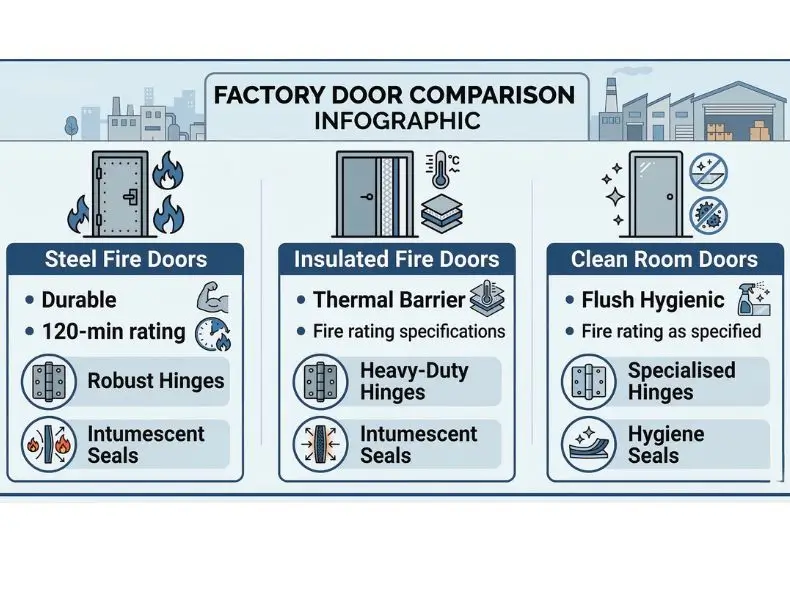
Below is a simplified view of how common industrial fire door solutions compare.
Common Fire Door Options for Industrial Sites
Each industrial facility usually needs a combination of these solutions, based on risk assessment, process mapping, and code requirements.
Industrial Fire Doors in High-Risk Zones
Certain zones in factories and warehouses demand special attention while planning fire rated doors.
High-risk areas typically include:
- Chemical and solvent stores
- Paint booths and curing ovens
- Transformer and DG rooms
- Bulk storage of flammable materials or packaging
In these areas, power-operated or sliding industrial fire doors may be used where large equipment or pallets move frequently. Nonetheless, they must still comply with IS 3614 or equivalent standards and ensure safe manual override in emergencies.
How KOR India Can Support Your Facility
KOR India specialises in designing and manufacturing heavy-duty industrial fire doors tailored to the demanding conditions of Indian factories and warehouses. By aligning solutions with IS 3614:2021, NBC requirements, and evolving BIS QCO mandates, KOR India helps plant owners move from basic compliance to robust, long-term risk mitigation.
Typical support includes:
- Selection of appropriate steel fire doors and fire rated doors for each zone based on risk and usage.
- Integration of clean room doors with fire resistance where required in pharma, food, or electronics environments.
- Assistance with documentation, labeling, and test reports for statutory approvals and audits.
Early coordination with design, safety, and maintenance teams ensures that door specifications, opening sizes, and hardware are planned correctly from the layout stage.
Practical Checklist Before Finalising Industrial Fire Doors
When you evaluate industrial fire doors for your factory or warehouse, use a simple, actionable checklist.
Verify:
- Compliance with IS 3614:2021 and presence of BIS (ISI) certification where applicable.
- Fire rating (60, 90, 120 minutes) suitable for the risk profile of each area.
- Provisions for smoke control through intumescent and cold smoke seals.
- Use of heavy-duty steel construction with appropriate GI thickness and fire-resistant infill.
- Fire-rated hardware, including closers, panic bars, and hinges, tested with the door assembly.
- Installation by trained teams in line with the manufacturer’s guidelines and IS requirements.
- Clear labels, traceable certificates, and maintenance plans in place.
For clean zones, also confirm that clean room doors satisfy both hygiene and fire norms where needed.
FAQ: Industrial Fire Doors for Factories and Warehouses
1. Are industrial fire doors mandatory in Indian factories?
2. What minimum fire rating should I choose for a warehouse?
It depends on the risk assessment and local codes, but many consultants recommend at least 60-minute industrial fire doors for general warehouse compartments and 90–120-minute ratings for high-risk or critical storage areas.
3. Why are BIS and ISI marks important for steel fire doors?
4. How often should industrial fire doors be inspected?
5. Can clean room doors also be fire rated?
Yes. Specially designed clean room fire doors can combine smooth, hygienic finishes with certified fire performance, provided they are tested and documented as per the relevant fire door standards.