
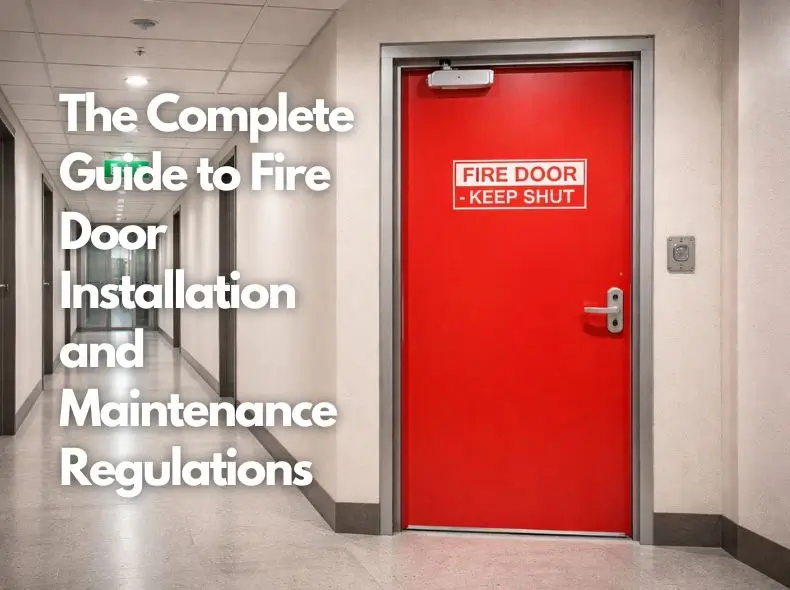
Commercial buildings in India are growing taller, denser, and more complex every year. Offices, malls, hospitals, and warehouses-each of them depends on safe evacuation routes and robust compartmentation to protect occupants during a fire. In many cases, the only thing slowing down flames and toxic smoke between two areas is a single door.
That is why regulators have tightened rules around how these doors are designed, where they are installed, and how they are maintained over the life of the building. The National Building Code (NBC) 2016 Part 4 and IS 3614:2021 now place clear responsibilities on builders, developers, and facility managers to get fire safety absolutely right.
From here onward, this guide walks through everything you need to know about fire door installation, ongoing fire door maintenance, and NBC compliant doors-with a special focus on Indian regulations and practical implementation on real projects.
1. The Regulatory Landscape for Fire Doors in India
Before discussing site practice, it helps to understand which codes and standards actually apply. In India, fire doors sit at the intersection of building regulations, product standards, and quality control orders.
1.1 National Building Code of India (NBC 2016 – Part 4)
NBC 2016 Part 4, “Fire and Life Safety”, is the core reference document for where fire doors are required, what fire ratings must be used, and how escape routes must be protected.
- Defines fire zones and occupancy groups (residential, business, industrial, assembly, etc.)
- Specifies where compartmentation and protected escape routes are mandatory
- States that all “fire doors” or “fire check doors” should be read as fire door assemblies (door leaf, frame, hardware, seals together)
- Prescribes fire resistance ratings for doors in staircases, shafts, corridors, firefighting shafts, pump rooms, industrial buildings, and more (often 60–120 minutes)
- Requires doors in exits to be self‑closing, fitted with intumescent seals, and never held open except by electromagnetic devices linked to the fire alarm system
In short, NBC tells you where doors must be and what fire rating is needed for that location.
1.2 IS 3614:2021 – Fire Doors and Doorsets
IS 3614:2021 is the product standard for fire doors and doorsets in India.
- Covers design, construction, materials, hardware, and performance for steel, timber, and composite doors
- Lays down test methods for fire resistance, integrity, insulation, and smoke‑tightness (usually EI30, EI60, EI90, EI120 classes)
- Sets minimum sheet thickness for steel leaves (for example, 0.8 mm for 60 minutes, 1.2 mm for 120 minutes, subject to passing tests)
- Limits maximum leaf sizes and glazing/vision panel areas for specific ratings
- Requires all fire doors to be self‑closing and to include intumescent and smoke seals as standard components.
- Includes explicit clauses on material handling, transportation, and installation so that tested performance is not lost on site.
In other words, NBC governs the building, while IS 3614:2021 governs the product and its installation.
1.3 BIS Certification and QCO 2025
Additionally, the Government of India has moved toward stricter quality control through a Quality Control Order (QCO) for fire doors and doorsets.
This QCO makes BIS certification under IS 3614:2021 mandatory for manufacturers and importers. Key points include:
- Only BIS‑licensed manufacturers may supply fire doors covered by IS 3614:2021
- Products must bear the ISI mark and be traceable to valid test reports and audits
- Non‑compliant or unmarked doors may be barred from use and can create serious legal exposure for builders and facility owners
Together, NBC 2016, IS 3614:2021, and the BIS QCO form the backbone of fire door regulation in India as of 2025.
2. Core Principles of NBC Compliant Doors
To remain NBC compliant, fire doors must do more than simply “look heavy.” They must perform reliably when a fire occurs, and they must be installed and maintained exactly as tested.
2.1 Fire Resistance Rating and Location
NBC ties minimum fire ratings to building use, height, and function. For example:
- Staircase doors, fire towers, and firefighting shafts – typically require 120‑minute fire‑resisting doors in high‑rise or non‑naturally ventilated areas
- Electrical shafts, service ducts, pump rooms, and high‑hazard storage – inspection or access doors often need at least 120 minutes
- Apartments, institutional areas, or lower‑risk compartments – may be allowed to use 20–60 minute doors depending on occupancy and layout
The fundamental principle is simple: the higher the risk or evacuation time, the higher the fire rating.
2.2 Fire Door Assembly, Not Just the Leaf
Both NBC and IS 3614 emphasize that a “fire door” means a tested assembly:
- Door leaf
- Frame
- Hinges and hardware (locks, latches, closers, panic bars, etc.)
- Intumescent and smoke seals
- Vision panels and fire‑rated glazing, if any
If any of these are substituted on site without being part of the tested configuration, the assembly may no longer be compliant.
2.3 Self‑Closing and Hold‑Open
NBC clearly states:
- Doors in exits must be self‑closing and must remain closed, except when held open by approved electromagnetic devices linked to the fire alarm system.
- During a fire, these devices release, and the closer must shut the door fully and latch it.
Therefore, fire door installation must always include correctly sized closers and, where used, compliant hold‑open devices.
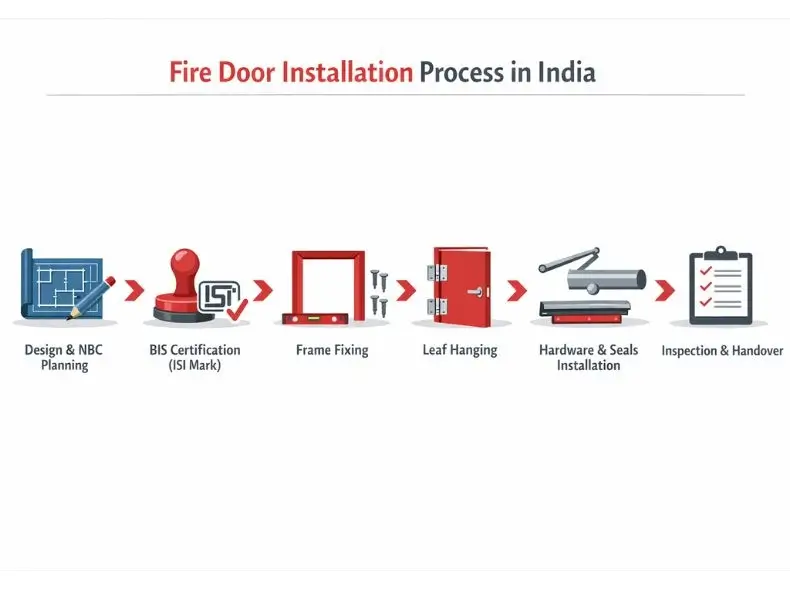
3. Fire Door Installation Requirements (NBC + IS 3614)
Now let’s look at what fire door installation should actually look like on site if you want truly NBC compliant doors.
3.1 Planning Before Installation
Before the first frame is fixed, responsible teams should:
- Review fire strategy drawings and NBC Part 4 to confirm required door locations and ratings
- Match each opening to a tested and certified doorset under IS 3614:2021 (including leaf size, rating, and hardware set)
- Verify that the manufacturer holds a valid BIS license and that test certificates are within their validity period (generally 5 years)
- Plan storage and handling on site so that doors are not bent, dented, or exposed to water before installation
This preparation step significantly reduces rework, delays, and compliance issues later.
3.2 Frame Installation
Proper frame fixing is the backbone of reliable fire door installation. IS 3614:2021 and good practice require:
- Frames must be plumb, level, and square, with correct reveal dimensions as per manufacturer’s drawings
- Fixing anchors or fasteners at the specified spacing and depth, compatible with the wall type (block, RCC, drywall, etc.)
- Use of approved fire‑rated mortar, mastic, or foam around the frame–wall interface according to test evidence
- No large voids or unfilled cavities around the frame that could allow fire or smoke to bypass the assembly
If frames are twisted or misaligned, the leaf will not close properly, and gaps will exceed allowable limits.
3.3 Leaf Hanging and Hardware Fitting
Once the frame is secure, the leaf and hardware require careful attention:
- Use only the hinges, locks, latches, closers, panic bars, flush bolts, and vision panels that are listed in the manufacturer’s tested assembly
- Fit at least three hinges per leaf (common for 2 m+ doors), with all screws fully driven and of the right grade
- Install surface or concealed closers per the manufacturer’s instructions; adjust closing speed so the door closes completely from any angle and latches firmly
- Ensure panic hardware (if required by NBC for assembly or institutional occupancies) operates smoothly and allows egress without keys
At this stage, installers should perform multiple open–close cycles to confirm consistent operation.
3.4 Gaps, Seals, and Thresholds
One of the most common reasons doors fail inspections is incorrect gaps. Various fire safety and insurance guidelines recommend roughly:
- 2–4 mm at the vertical edges and head
- Up to about 10 mm at the threshold (or as approved in the test evidence)
Additionally:
- Intumescent seals must be continuous around the leaf or frame as designed, with no cuts or missing sections
- Cold smoke seals should lightly contact the frame without preventing smooth closing
- Thresholds should not introduce trip hazards yet must not leave large under‑door gaps
If gaps are too large, smoke and hot gases will pass through long before the required rating time.
3.5 Signage, Labelling, and Handover
NBC Part 4 also stresses that all fire‑rated doors and assemblies must be provided with certificates and labels. A fully compliant fire door installation should end with:
- Permanent labels or tags on the leaf/frame showing manufacturer, rating (for example, 60 min, 120 min), standard (IS 3614:2021), and year of manufacture
- “Fire Door – Keep Shut” or equivalent signage on both sides of the door in critical locations
- An as‑built schedule shared with the building owner, listing each door location, rating, and certificate reference
This documentation becomes vital during fire audits, insurance inspections, and occupancy certification.
4. Step‑by‑Step Fire Door Installation Checklist
To make things more practical, here is a simplified checklist that site engineers and contractors in India can use.
4.1 Pre‑Installation
- Confirm opening size matches certified door size and rating
- Verify BIS license number and ISI mark for the doorset
- Check that all components (leaf, frame, hardware, seals) match the approved schedule
- Inspect doors for transport damage, warping, or corrosion
4.2 Frame Fixing
- Position frame accurately; check for plumb, level, and square
- Fix anchors as per drawing and tighten securely
- Fill gap between frame and wall with approved fire‑rated material
- Clean off any debris or excess sealant that can obstruct leaf movement
4.3 Leaf and Hardware
- Hang leaf with specified hinges and screws
- Fit closer and adjust closing speed and latching force
- Install latches, locks, exit devices, and any electric strikes as per test configuration
- Add intumescent and smoke seals where required
4.4 Testing and Handover
- Cycle door multiple times; ensure smooth and full closure
- Measure gaps around perimeter and at threshold
- Confirm signage and rating labels are fixed
- Record installation details in the fire door register for future maintenance
When this checklist is followed consistently, NBC compliant doors are much easier to achieve and keep that way.
5. Fire Door Maintenance Regulations and Best Practices
Installing a door correctly is only half the journey. Fire doors are life‑safety equipment, and several guidance documents stress that they must be inspected and maintained regularly to remain effective.
5.1 Legal and Regulatory Expectations
While NBC 2016 focuses more on design and installation, other Indian guidance and insurance requirements emphasize maintenance:
- Regular inspections are expected, especially in high‑occupancy or high‑risk buildings
- Records of inspections, defects, and rectification should be kept and produced during audits
- Many insurance policies require proof that fire doors and other passive fire protection elements are kept in working order
Internationally, best practice is to inspect fire doors at least every six months, and more frequently in very high‑traffic areas or high‑risk buildings. Indian insurers and safety professionals increasingly recommend similar frequencies.
5.2 Roles and Responsibilities
Typically, the following are responsible:
- Building owner or employer – overall responsibility to ensure safe workplaces and NBC compliance
- Facility manager or “responsible person” – day‑to‑day management of inspections, maintenance, and record keeping
- Approved fire door contractor or manufacturer’s service team – repair, replacement, and technical support
Therefore, fire door maintenance is not optional; it is part of your legal duty of care.
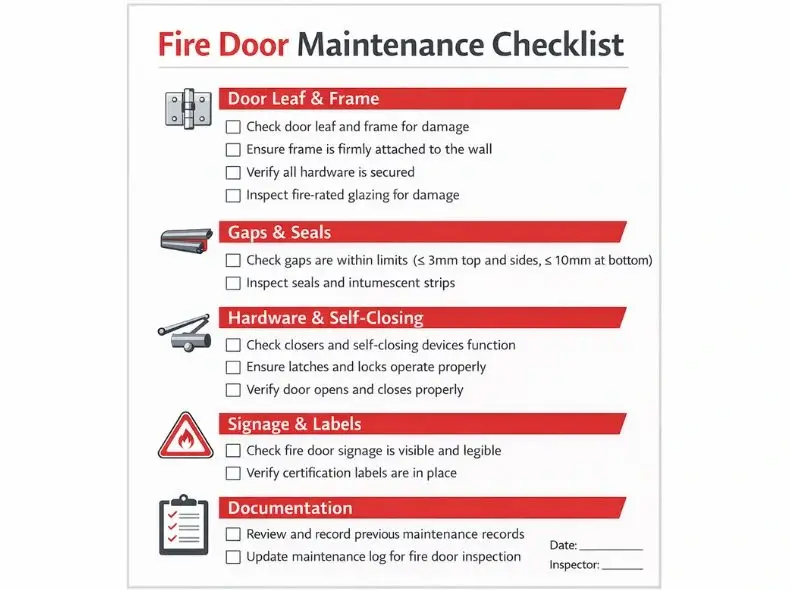
6. Fire Door Maintenance Checklist
For practical implementation, a structured checklist is essential. During routine inspections, each fire door assembly should be checked for the following.
6.1 Door Leaf and Frame
- No warping, cracking, delamination, or severe dents
- No unapproved holes drilled for cables or new hardware
- Frame firmly anchored; no looseness or visible gaps with the wall
If any damage compromises integrity, the door may no longer meet its tested rating.
6.2 Gaps and Seals
- Gaps along edges and head remain around 2–4 mm; threshold gap remains within acceptable limit
- Intumescent and smoke seals are continuous, unpainted, and undamaged
- No missing segments, compression damage, or debris preventing proper contact
Even small missing sections of seals can allow early smoke spread.
6.3 Hardware and Self‑Closing
- Door closes fully and latches securely every time, from any open angle
- Closer is not leaking oil and is firmly fixed
- Hinges are tight, with all screws present and no excessive wear
- Panic bars or exit devices operate smoothly and are not obstructed
If a door does not self‑close and latch, it cannot function as intended in a fire.
6.4 Signage, Labelling, and Hold‑Open
- Required signage (“Fire Door Keep Shut” or similar) is visible and not removed
- Certification and rating labels are intact and readable
- Any hold‑open devices are electromagnetic and connected to the fire alarm-not wedges, hooks, or doorstops
Non‑approved hold‑open methods are a frequent and serious violation.
6.5 Documentation
- Inspection date, inspector’s name, and findings recorded for each door
- Defects categorized by urgency and rectified within defined timelines
- Records retained and available for audits, insurer visits, or statutory inspections
Consistent record‑keeping demonstrates due diligence and can significantly reduce liability.
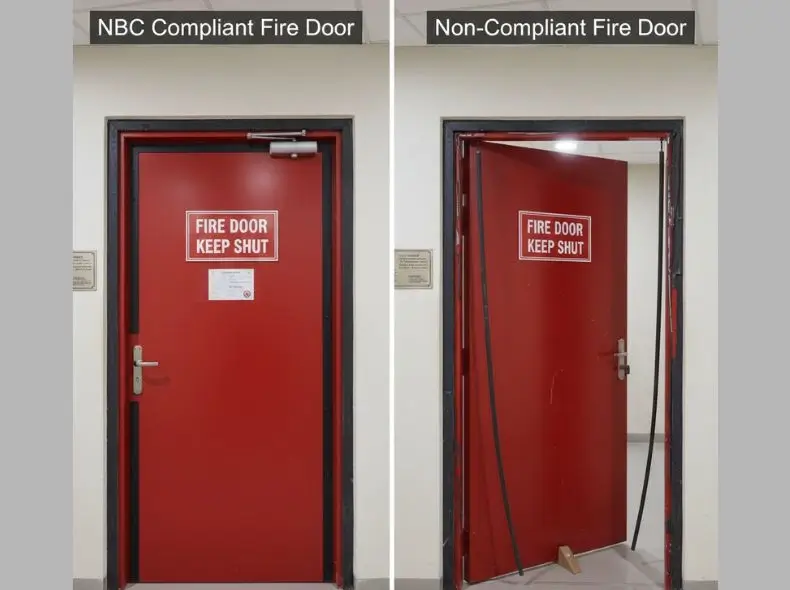
7. Fire Door Certification and NBC Compliant Doors
Choosing the right product and keeping its documentation organized is just as important as correct fire door installation.
7.1 What Fire Door Certification Should Include
For each certified doorset, you should have:
- Test reports or assessment from an IS 3614:2021‑accredited lab (for example, CBRI or NABL‑accredited facilities)
- Scope of approval listing leaf type, frame, hardware, glazing, rating, and maximum sizes
- BIS license documentation and ISI marking details
- Manufacturer’s installation manual and maintenance guidance
This paperwork proves that the door is capable of achieving its claimed rating under standard test conditions.
7.2 NBC Compliant Doors in Practice
An NBC compliant door is one that:
- Has been tested and certified to IS 3614:2021 (or accepted equivalent) for the correct rating and configuration.
- Is installed strictly as per the tested assembly and manufacturer’s instructions.
- Is located in the building where NBC Part 4 requires a door of that rating.
- Is inspected, maintained, and documented throughout its service life.
Consequently, using uncertified or improperly maintained doors can lead to serious non‑compliance, even if the door “looks” like a fire door.
8. Designing a Compliance Strategy for Your Building
Instead of treating each door in isolation, it is far better to treat fire doors as part of a building‑wide passive fire protection strategy.
8.1 During Design and Construction
- Involve a qualified fire consultant early to map compartmentation and escape routes
- Coordinate with a reputable manufacturer to select appropriate ratings and hardware for each opening
- Ensure tender documents specify BIS‑certified, IS 3614:2021‑compliant doors only
- Include clear installation responsibilities and acceptance criteria in contracts
This integrated approach reduces clashes later between architectural, MEP, and fire safety requirements.
8.2 During Operation and Maintenance
- Create a fire door register listing each door ID, location, rating, and manufacturer
- Schedule inspections (for example, every 6 months or more often in high‑traffic zones)
- Train housekeeping and security teams to spot basic defects-wedged doors, damaged seals, missing closers
- Budget annually for repair or replacement of non‑compliant doors
By building systems around fire door installation and maintenance, compliance becomes routine rather than a last‑minute scramble before audits.
9. How KORIndia Supports Compliant Fire Door Installation and Maintenance
For many projects, managing codes, standards, and paperwork can feel overwhelming. That is where a specialist manufacturer makes the difference.
KORIndia focuses on BIS‑certified, IS 3614:2021‑compliant fire doors for commercial, industrial, healthcare, and infrastructure projects across Delhi NCR and beyond. Our offerings are designed to simplify your compliance journey:
- End‑to‑end support – from door scheduling and rating selection to on‑site fire door installation supervision
- CBRI‑tested assemblies – steel fire doors with EI60, EI90, and EI120 ratings, complete with compatible hardware and seals
- NBC‑aligned design – doorsets configured specifically for staircases, shafts, pump rooms, and industrial zones as per NBC Part 4 requirements
- Documentation pack – test reports, BIS license details, installation manuals, and maintenance guidelines handed over at project completion
- After‑sales and AMC – periodic inspection and maintenance services to keep your doors compliant throughout their life
If you are planning a new project-or need to upgrade existing fire doors for audits or insurance- KORIndia can help you design a practical, regulation‑aligned solution.
Looking to ensure your building has truly NBC compliant doors from day one? Reach out to KORIndia for a site assessment, compliant fire door installation plan, and long‑term maintenance support tailored to your project.
FAQs: Fire Door Installation, Maintenance, and Regulations
1. How often should fire doors be inspected in India?
Most safety and insurance guidance suggests inspecting fire doors at least every six months, and more frequently in high‑traffic areas such as malls, hospitals, and schools. Local fire authorities or insurers may demand stricter schedules for high‑risk occupancies.
2. Who is allowed to carry out fire door installation?
While NBC does not list specific trades, best practice is to use manufacturer‑trained installers or experienced contractors who follow IS 3614:2021‑based instructions. Incorrect installation can invalidate the fire rating, even if the door itself is certified.
3. What exactly is an NBC compliant door?
An NBC compliant door is a fire door assembly that:
- Is tested and certified to IS 3614:2021 (or accepted equivalent) for the required rating,
- Is installed in the correct location according to NBC Part 4,
- Includes proper self‑closing hardware and seals, and
- Is maintained and documented throughout its service life.
4. Are BIS and ISI marks compulsory for fire doors?
Yes. Under the BIS Quality Control framework and IS 3614:2021, BIS certification and ISI marking are effectively mandatory for regulated fire doors and doorsets supplied in India. Using non‑certified doors can lead to non‑compliance and legal or insurance issues.
5. What are the most common reasons fire doors fail inspections?
Typical failures include doors that do not self‑close properly, excessive gaps, damaged or missing seals, unapproved hardware substitutions, wedged‑open doors, and missing labels. Regular fire door maintenance and user training greatly reduce these issues.