
When a fire breaks out, seconds matter. The difference between a safe evacuation and a catastrophic event often hinges on one critical infrastructure component: fire-rated doors. Yet despite their importance, many building managers, architects, and facility owners don’t fully understand what makes a quality fire door or how to choose the right fire-rated door manufacturer for their needs.
This comprehensive guide cuts through the complexity. Whether you’re constructing a commercial building, retrofitting an industrial facility, or managing healthcare infrastructure, understanding steel fire doors isn’t just about compliance—it’s about protecting lives and property. We’ll walk you through everything you need to know: from technical specifications to installation best practices, from certification standards to maintenance protocols.
The stakes are high, and the details matter. Let’s explore what separates a mediocre fire door from one that truly performs when it matters most.
What Are Steel Fire Doors? Understanding the Fundamentals
The Core Definition
A fire rated door manufacturer creates specialized door assemblies designed to withstand intense heat and prevent the spread of fire, smoke, and toxic gases from one area of a building to another. Steel fire doors represent the most robust option in this category, constructed from heavy-duty steel components engineered to meet stringent fire-resistance standards established by Indian and international regulatory bodies.
Unlike ordinary doors that fail within minutes when exposed to fire, steel fire doors maintain their structural integrity and sealing capability for specified durations. This critical difference gives occupants precious time to evacuate safely while simultaneously limiting property damage and giving emergency responders a more manageable situation.
Why the Material Matters
Steel possesses inherent advantages that make it the preferred material for fire-rated doors. Unlike wood, which combusts, or composite materials that degrade rapidly at high temperatures, steel maintains its strength even when exposed to temperatures exceeding 1000°C. The material doesn’t warp easily, resists moisture absorption, and provides superior security features compared to alternative materials.
A quality fire-rated door manufacturer combines this steel construction with specialized infill materials and sealing systems. These components work synergistically—the steel frame provides structural support, while mineral-based infill cores and intumescent seals deliver the fire resistance rating. This multi-layered approach ensures that doors perform exactly as tested and certified, regardless of real-world fire conditions.
Why Fire Rated Doors Are Essential in Modern Buildings
Life Safety: The Primary Imperative
The fundamental purpose of every fire–rated door manufacturer‘s product is straightforward: save lives. Fire doors compartmentalize buildings, creating barriers that slow fire spread and allow occupants more time to reach safety. In high-rise residential buildings, office complexes, and hospitals, properly functioning fire doors can mean the difference between a managed evacuation and a tragedy.
According to building safety data, most fire fatalities result not from burns but from smoke inhalation. Fire-rated doors prevent smoke migration through corridors and stairwells, maintaining breathable air in exit routes. Furthermore, these doors protect firefighters by limiting the fire’s spread and creating safer conditions for rescue operations.
Regulatory Compliance and Legal Requirements
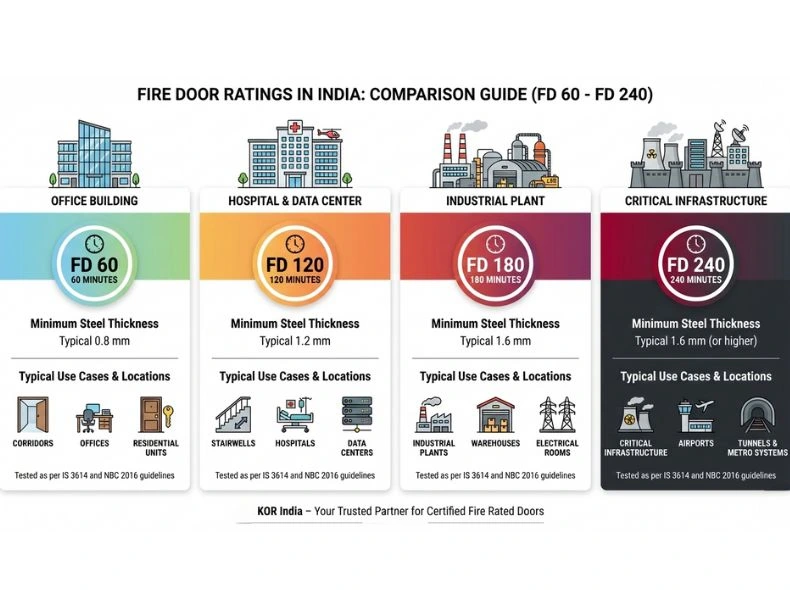
India’s National Building Code 2016 (NBC 2016) mandates fire-rated doors in specific building types and locations. A competent fire-rated door manufacturer ensures that their products meet these regulatory requirements, protecting building owners from liability while ensuring occupant safety.
The NBC 2016 specifies:
- Stairwell exits require 120-minute fire-rated doors
- Corridor fire separations typically require 60-minute doors
- Fire command centers need 120-minute rated assemblies
- Service shafts require minimum 30-minute rated doors
Non-compliance with these standards can result in construction project delays, failed inspections, penalties, and ultimately, compromised safety.
Property Protection and Business Continuity
Beyond human safety, fire-rated doors protect valuable assets. In data centers, financial institutions, and manufacturing facilities, fire containment directly translates to reduced property losses and faster business recovery. Moreover, insurance premiums often reflect the presence of certified fire protection systems, including properly maintained fire-rated doors.
Fire Door Standards and Regulations in 2025: What You Must Know
IS 3614:2021 – India’s Core Fire Door Standard
The Indian Standard IS 3614:2021 represents the most comprehensive guideline for fire doors and door sets. This revised standard, updated from previous versions, incorporates lessons learned from fire incidents and reflects best international practices adapted for Indian building conditions.
Every reputable fire-rated door manufacturer in India designs and manufactures according to IS 3614:2021 specifications. This standard covers:
- Door leaf thickness requirements: Minimum 1.2mm (18 gauge) galvanized steel for 120-minute doors
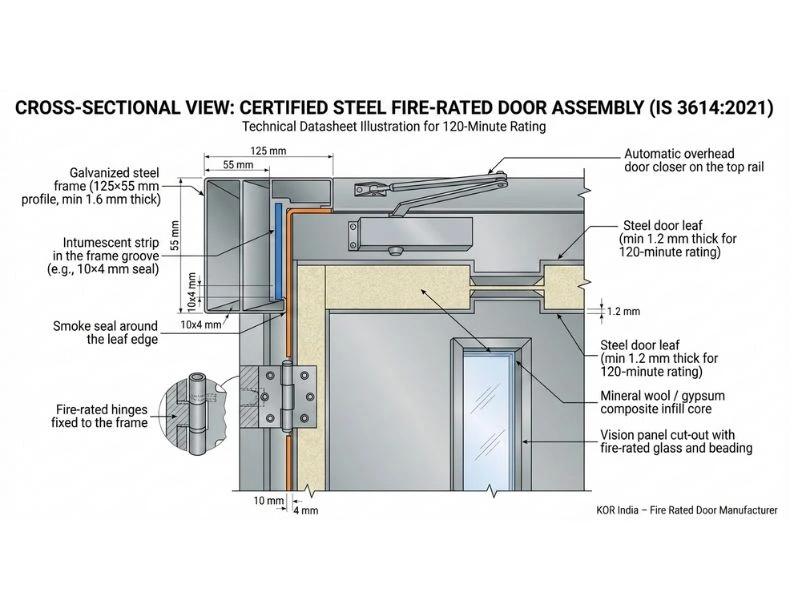
- Frame specifications: Single rebate grooved profiles measuring 125x55mm, minimum 1.60mm (16 gauge) thickness
- Infill materials: Approved materials include gypsum, mineral composites, ceramic wool, and resin-bonded honeycomb—but explicitly excludes polyurethane foam
- Sealing requirements: Mandatory intumescent seals and smoke seals for all certified assemblies
- Vision panel limitations: Maximum 0.12 m² for uninsulated doors, 0.06 m² for insulated doors
NBC 2016: National Building Code Requirements
The National Building Code 2016 provides the legal framework for fire safety in Indian buildings. This code mandates fire-rated doors in specific applications and specifies their placement, ratings, and operational requirements.
Key NBC 2016 provisions include:
- Self-closing mechanisms: All fire doors must have automatic self-closing devices capable of closing from any angle
- Hold-open prohibition: Fire doors in exits cannot remain permanently held open
- Certification requirements: All doors must display manufacturer identification, fire rating, and testing certification
- Exit door swinging: Doors must swing in the direction of exit travel
- Double-leaf coordination: When two doors are used, a coordinator must sequence their closing during emergencies
BIS Certification: The Mandatory Mark of Quality
The Bureau of Indian Standards (BIS) certification represents the government’s official endorsement that a product meets stringent quality standards. Any fire-rated door manufacturer seeking to supply fire doors for regulated applications must obtain BIS certification. This isn’t optional—it’s mandatory for building compliance.
The BIS certification process involves:
1. Third-party testing at approved laboratories (CBRI Roorkee, IIT Gandhinagar, Gujarat Test House)
2. Performance verification against IS 3614:2021 standards
3. Quality system certification of the manufacturing facility (typically ISO 9001:2015)
4. Ongoing surveillance through periodic testing and facility audits
5. Certificate validity of five years, with retesting required if manufacturing processes change
Types of Steel Fire Doors: Finding the Right Solution
Insulated vs. Uninsulated Fire Doors
The distinction between insulated and uninsulated fire doors fundamentally affects their application and performance characteristics. Understanding this difference is crucial when selecting from a fire-rated door manufacturer.
Insulated Fire Doors (FD 120-I, FD 180-I)
- Provide both integrity and insulation ratings
- Prevent heat transmission to the unexposed side
- Recommended for compartmentation walls and high-risk areas
- Higher cost but superior fire protection
- Typical insulation period: 30 minutes minimum
Uninsulated Fire Doors (FD 120, FD 60)
- Maintain integrity but allow some heat transmission
- Suitable for exit doors and corridors
- Lower cost alternative
- Performance focused on smoke and flame containment
- Common in residential stairwells
Fire Rating Classifications Explained
Fire ratings are expressed as FD followed by minutes: FD 30, FD 60, FD 120, FD 180, or FD 240 (maximum for rolling shutters). Each rating indicates the minimum duration the door maintains integrity during a standardized fire test.
FD 60 (60-Minute Rating)
- Suitable for industrial facilities and commercial offices
- Meets most NBC 2016 corridor requirements
- Common choice for manufacturing units and warehouses
FD 120 (120-Minute Rating)
- Premium choice for high-security and critical infrastructure
- Required for stairwell exits, fire command centers, and transformer rooms
- Standard recommendation for hospitals and data centers
- Most versatile rating for multi-use buildings
FD 180 (180-Minute Rating)
- Highest-rated hinged fire door assembly
- Specified for specialized high-risk applications
- Often used in critical infrastructure and chemical storage facilities
Single vs. Double Leaf Configurations
Single-leaf doors (up to 1,250mm wide) serve most standard applications. However, larger openings require double-leaf configurations, each capable of independently closing the opening. A competent fire-rated door manufacturer ensures proper coordination between leaves using specialized hardware.
Key Components: What Makes a Fire Door Work
Steel Frames and Their Critical Role
The door frame forms the foundation of a fire-rated assembly. Specifications matter immensely—a frame manufactured to IS 3614:2021 standards features:
- Grooved single-rebate profiles to accommodate sealing strips
- Galvanized steel construction (minimum 16 gauge/1.60mm thickness)
- Mitered corners for seamless integrity
- Pre-punched mounting points for hinges and closers
- Factory-prepared grooves sized for specific seal dimensions
An inadequate frame compromises even the best door leaf, which is why choosing an experienced fire-rated door manufacturer is crucial. The frame must align perfectly with the door leaf to maintain integrity during the fire test and throughout the door’s operational life.
Intumescent and Smoke Seals: The Invisible Protection
Perhaps the most misunderstood component of fire doors, intumescent seals remain dormant during normal operation but transform dramatically when exposed to heat. These specialized materials expand 5-20 times their original volume when temperatures exceed 150-200°C, creating a pressure-tight barrier that blocks smoke, flames, and hot gases.
Smoke seals serve a complementary function, creating continuous barriers along door edges and preventing smoke migration even before intumescent activation. Under IS 3614:2021 regulations, every certified fire-rated door manufacturer must incorporate both seal types as standard components.
Regular inspection reveals when seals deteriorate or compress excessively, necessitating replacement to maintain the fire rating. This maintenance requirement shouldn’t be viewed as an inconvenience but as essential fire protection assurance.
Door Closer Mechanisms: Ensuring Reliable Closure
Automatic door closers installed on fire-rated doors must themselves be fire-rated and capable of closing the door from any angle. The closer provides controlled closure—important for preventing slamming while still ensuring complete closure when needed.
Advanced specifications require specific torque ratings (typically 2-4 Nm) to ensure smooth operation without excessive force that could damage seals. An experienced fire-rated door manufacturer selects closers that complement the door assembly while meeting all relevant standards.
Hardware: Hinges, Locks, and Latches
Every piece of hardware on a fire-rated door assembly must meet standards equivalent to or exceeding the door’s fire rating. Steel hinges (never aluminum or brass), fire-rated latches, and appropriately torqued fasteners all contribute to overall performance. The door simply cannot be certified if hardware is substandard or installed improperly.
Vision Panels: Balancing Safety and Functionality
Many applications require vision panels (glazed sections) in fire doors for visibility. However, regulations strictly limit glass area based on fire rating. An uninsulated FD 120 permits maximum 0.12 m² of glass, while insulated doors allow only 0.06 m². The glazing material itself must be fire-rated, not standard window glass. A knowledgeable fire-rated door manufacturer guides customers on panel placement and size to ensure code compliance while maintaining functionality.
The Manufacturing Process: How Quality Fire Doors Are Made
Material Selection and Core Construction
Quality begins with material selection. A disciplined fire-rated door manufacturer sources galvanized steel sheets meeting IS 277 standards, with proper thickness verification and documentation. The door’s core—essentially its fire resistance engine—requires equally careful attention.
Approved infill materials include:
- Mineral wool: Excellent fire resistance with good insulation properties
- Gypsum composites: Reliable performance with consistent quality
- Ceramic wool: Premium option for maximum fire protection
- Resin-bonded honeycomb: Lightweight alternative providing good structural support
Each material undergoes testing to verify fire resistance performance. The choice between materials affects door weight, cost, and specific fire characteristics—a decision that should align with the intended application.
Frame and Leaf Assembly
Manufacturing begins with precise frame construction. Galvanized steel is cut to exact dimensions, with grooves routed to accommodate sealing strips. The frame pieces are then mitered at corners and welded or riveted to create a rigid structure capable of supporting the door leaf and withstanding fire stress.
The door leaf itself follows similarly rigorous processes. Steel sheets are bent and welded to create a hollow shell, which is then filled with approved infill material. The infill must bond completely to the steel surfaces, creating a monolithic assembly rather than loose-fill that could shift during fires.
Sealing System Integration
Intumescent and smoke seals are incorporated during manufacturing rather than applied afterward. This factory integration ensures consistent performance and proper adhesion. Seals are carefully selected based on the specific fire rating and application, as different seal compositions expand at different rates and to different volumes.
Hardware Installation and Testing Preparation
Hinges, closers, and other hardware are installed and torque-tested to specification. Every assembly undergoes quality checks before leaving the manufacturing facility, including dimensional verification and visual inspection for welds, corrosion, or defects.
Certification and Third-Party Testing
Before any door can carry an IS 3614 certification mark, it must undergo rigorous third-party testing at approved laboratories. The test exposes the complete assembly (frame, door, hardware, seals, and all) to ISO 834-1 time-temperature curves that simulate a standard fire.
Evaluators monitor for:
- Integrity: No flames passing through gaps after 6mm tolerance testing
- Insulation: Temperature rise limits on the unexposed surface
- Stability: Structural integrity maintenance throughout the test
- Smoke seal effectiveness: Ensuring smoke blockage
Only after successful testing and documentation can a fire-rated door manufacturer affix the certification label and deliver doors to customers with confidence.
Technical Specifications: Meeting 2025 Standards
Door Leaf Specifications for Different Ratings
The relationship between steel thickness and fire rating is direct and critical:
| Fire Rating | Minimum Thickness | Maximum Width | Core Material |
|---|---|---|---|
| FD 60 | 0.8mm (20 gauge) | 1,250mm | Mineral composite |
| FD 120 | 1.2mm (18 gauge) | 1,250mm | Mineral composite/gypsum |
| FD 180 | 1.6mm (16 gauge) | 1,250mm | High-density mineral |
These specifications aren’t arbitrary—they’re the minimum requirements verified through standardized testing. Any fire-rated door manufacturer deviating from these specifications risks product failure during actual fires or during regulatory inspections.
Frame Profile Specifications
Standard fire door frames feature 125x55mm single-rebate grooved profiles with specific groove dimensions for seal accommodation. The groove must measure 10x4mm for standard smoke and intumescent seal sizes. Frames must be mitered at corners and finished with non-combustible thresholds.
Hinge and Hardware Torque Specifications
Hinges must be steel (grade 7 minimum, grade 14 preferred) with torque specifications meeting BS EN 1935 standards. The low torque requirement (2-4 Nm) prevents excessive pressure on seals while ensuring smooth operation. Hinges must be fitted with three or four per leaf depending on door height and weight.
Smoke and Intumescent Seal Dimensions
Standard seal dimensions are 10x4mm for edge seals, with head and jamb locations critical for performance. Seals must be continuous around the entire perimeter without gaps or overlaps that could allow smoke or flame passage.
Installation: Getting It Right From Day One
The Professional Installation Imperative
A perfectly manufactured fire-rated door can fail if installation is improper. This is why a reputable fire–rated door manufacturer recommends—often mandates—installation by certified professionals. The stakes are simply too high for DIY installation or use of unskilled labor.
Professional installers ensure:
- Proper frame alignment in the opening
- Level and plumb installation verified with precision tools
- Correct seal seat preparation
- Hardware torque verification
- Appropriate clearances maintained throughout
- Closure operation testing
Critical Installation Specifications
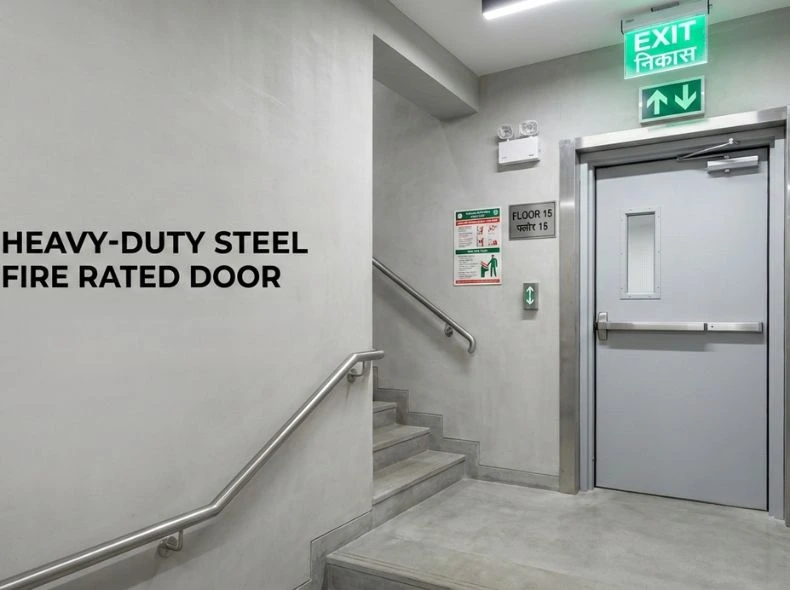
Clearances are tightly controlled—maximum gaps between door and frame vary depending on location, typically ranging from 3-4mm at the sides to 6mm at the bottom. Exceeding these tolerances can compromise fire protection. Improper installation with excessive gaps essentially voids the fire rating, regardless of the door’s tested performance.
The threshold installation requires particular attention—it must be non-combustible, properly secured, and aligned flush with adjacent flooring. Gaps at the door bottom must not exceed 6mm for most applications and 3mm for smoke barrier requirements.
Field Preparation and Installation Records
Before installation, the opening must be properly prepared according to manufacturer and regulatory specifications. The structural opening must be square and plumb, and the wall composition must match the tested assembly. If installation conditions differ materially from the tested assembly (different wall thickness, different frame condition), the fire rating may not apply.
All installation work must be documented with photographs and installation completion certificates retained for building records. This documentation proves compliance if future inspections occur.
Maintenance: Ensuring Long-Term Performance
Post-Installation Inspection Requirements
The first critical inspection occurs immediately after installation, before the door enters service. This acceptance test verifies:
- Proper frame installation and alignment
- Door leaf seating and operation
- Closure device functionality
- Seal integrity and positioning
- Hardware presence and proper torque
- Clearance verification at all points
This inspection generates records that must be retained for the building’s entire life.
Annual Maintenance and Inspection Protocol
Beyond the initial inspection, fire-rated doors require annual maintenance checks following NFPA 80 standards (adopted by NBC 2016). Each inspection should verify:
- No visible damage to door, frame, or hardware (no rust, warping, cracks)
- Seals remain continuous without compression or deterioration
- Hardware functions smoothly (hinges, closer, latch)
- Clearances remain within specification (gaps haven’t increased)
- Closure operation functions from any angle
- No field modifications have been made that void certification
Building managers should maintain a log recording inspection dates, personnel, findings, and any repairs performed.
Common Maintenance Issues and Solutions
- Compressed Seals: Normal compression over years requires seal replacement. Don’t ignore this—compressed seals lose fire-protective capability.
- Hardware Deterioration: Rust on hinges or closers indicates maintenance deficiency. Replace affected components immediately.
- Closure Adjustment: Doors closing too slowly or too quickly indicate closer adjustment is needed. Have certified technicians perform adjustments.
- Path Obstruction: Blocked doorways compromise evacuation capability. Maintain clear access at all times.
Applications: Where Steel Fire Doors Are Installed
Commercial and Corporate Buildings
Modern office complexes require fire-rated doors at multiple points:
- Stairwell exits: Mandatory 120-minute doors in multi-story buildings
- Corridor fire separations: Creating compartmented zones limiting fire spread
- Server rooms and IT facilities: Protecting critical equipment and data
- Executive suites and conference rooms: Meeting safety and security requirements
Healthcare Facilities
Hospitals and clinics have the most stringent fire protection requirements:
- Operating theaters: Requiring 120-minute insulated doors
- Patient rooms: Multiple doors per floor for safe evacuation
- Critical care units: Specialized layouts with fire door coordination
- Medication storage and sterile supply: High-security fire-rated access
Industrial and Manufacturing Units
Factories and manufacturing facilities need fire doors specific to their hazards:
- Hazardous material storage: 180-minute or 240-minute rolling shutters
- Chemical processing areas: Meeting special safety protocols
- Production floors: Compartmenting high-risk zones
- Transformer and electrical rooms: Protecting critical infrastructure
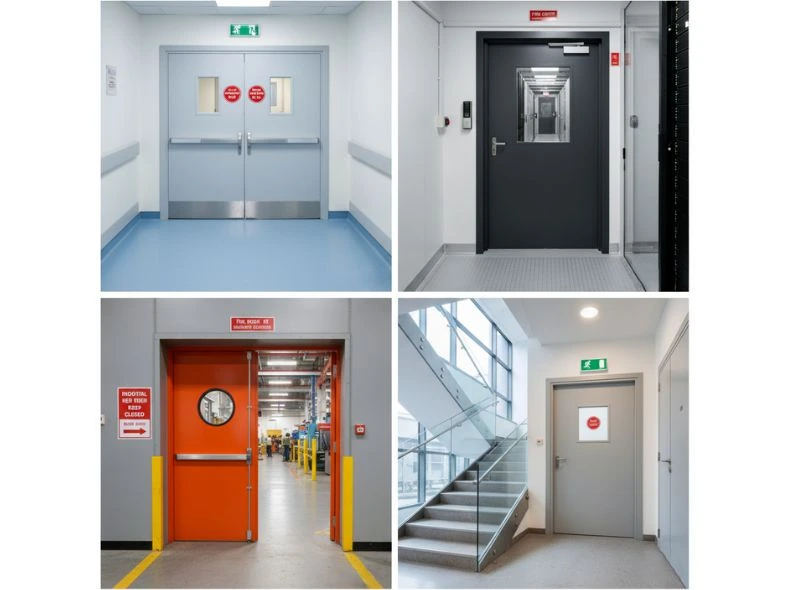
Data Centers
The concentration of electrical equipment and high-value servers makes data centers fire-critical:
- Server pods: Isolated with 120-minute fire-rated doors
- Equipment rooms: Protecting million-dollar installations
- Backup power systems: Separating generator areas
- Cooling systems: Protecting infrastructure critical to operations
Educational Institutions
Schools and universities implement fire-rated doors systematically:
- Corridors: Creating evacuation routes
- Stairwells: Protecting escape paths
- Administrative areas: Meeting building code requirements
- Laboratory buildings: Handling hazardous materials safely
Residential Complexes
Multi-family residential buildings increasingly incorporate fire-rated doors:
- Stairwell exits: Required in buildings exceeding three stories
- Lobby areas: Compartmenting residential from common areas
- Mechanical rooms: Protecting building systems
- Elevator lobbies: Some jurisdictions requiring separation
Choosing the Right Fire Rated Door Manufacturer: A Practical Guide
Certification and Credentials Matter
Not every door labeled “fire-rated” delivers genuine protection. A legitimate fire-rated door manufacturer provides:
- BIS License: Mandatory certification from Bureau of Indian Standards
- CBRI Testing Records: Third-party verification from Central Building Research Institute, Roorkee, or similar approved laboratories
- ISO 9001:2015 Certification: Demonstrating quality management systems
- Third-Party Certifications: Marks from Intertek, Certifire, or UL for international credibility
- Transparent Documentation: Complete test reports available for review
Manufacturers unwilling to provide these credentials should be considered ineligible, regardless of price or convenience.
Experience and Track Record
Established manufacturers bring decades of experience in fire door performance and installation. They’ve navigated regulatory changes, learned from field experience, and refined their processes. When evaluating manufacturers, inquire about:
- Years in operation: How long have they manufactured fire doors?
- Reference projects: Can they provide installations in similar applications?
- Standards evolution: Do they actively track and implement standard updates?
- Technical support: Do they provide consultation to architects and contractors?
Technical Support and Consultation
Quality manufacturers provide more than just products. They offer:
- Specification guidance: Helping architects select appropriate ratings and configurations
- Installation oversight: Ensuring proper assembly procedures
- Maintenance training: Educating building managers on inspection protocols
- Troubleshooting: Diagnosing and resolving issues with existing installations
Customization Capabilities
While standardized configurations address most applications, unique requirements sometimes emerge. A comprehensive fire-rated door manufacturer can provide:
- Custom sizing: Accommodating non-standard openings
- Specialized finishes: Meeting aesthetic or security requirements
- Glazing options: Incorporating vision panels within regulatory limits
- Hardware variations: Integrating with building security or access control systems
Cost Considerations and Value
Fire-rated doors represent significant investment—typically ranging from ₹40,000 to ₹1,20,000 per unit depending on rating, size, and customization. However, cost shouldn’t be the primary selection criterion.
The cheapest door isn’t the best value if it:
- Requires replacement within a few years
- Necessitates extra maintenance costs
- Fails fire performance during emergencies
- Creates regulatory compliance issues
Conversely, premium pricing doesn’t guarantee superior performance. Evaluate cost relative to:
- Certification status and testing records
- Warranty coverage
- Technical support availability
- Installation quality assurance
Common Misconceptions About Fire Doors: Separating Myth from Reality
“Any Metal Door Provides Fire Protection”
Reality: Steel doors used for security or weather protection are not fire-rated. Fire-rated doors require specific construction, testing, and certification. An unapproved steel door might actually accelerate fire spread by trapping heat inside sealed spaces. Only doors tested and certified to IS 3614 or equivalent standards provide genuine fire protection.
“Once Installed, Fire Doors Need No Maintenance”
Reality: Fire doors require annual inspections and maintenance. Seals compress, hardware wears, and door clearances can shift. Deferred maintenance virtually guarantees performance failure when a fire occurs. Annual inspections, often required by insurance policies, verify continued functionality.
“Fire Doors Can Be Propped Open Indefinitely”
Reality: Propped-open fire doors are dysfunctional fire doors. Regulations explicitly prohibit holding fire doors permanently open without automatic closing mechanisms. Electromagnetic hold-open devices with smoke detectors provide a code-compliant alternative for applications requiring open doors during normal operations.
“Replacing Doors Voids The Fire Rating”
Reality: Replacing individual components like closers or hardware may void the rating only if the replacement components don’t meet specification. Using equivalent approved components won’t affect certification. However, installing non-fire-rated components would compromise the assembly.
“All Fire Doors Look Industrial and Ugly”
Reality: Modern fire-rated doors integrate seamlessly into contemporary building designs. Powder-coated finishes in various RAL colors provide aesthetic appeal. Glazing options, handle styles, and frame designs offer customization possibilities. Fire protection and aesthetics aren’t mutually exclusive.
Fire-Rated Doors and Building Safety Integration
Relationship with Other Fire Protection Systems
Fire-rated doors don’t function in isolation. They complement comprehensive fire protection strategies including:
- Fire detection systems: Automated smoke detectors triggering alarm sequences
- Sprinkler systems: Controlling fire intensity while compartments contain spread
- Emergency lighting: Guiding occupants safely during evacuation
- Fire extinguishers and suppression: Providing immediate response capability
- Emergency communication systems: Coordinating evacuation efforts
An effective building fire safety strategy integrates all these systems, with fire doors serving as the compartmentation backbone.
Coordination with Building Management Systems
Modern buildings increasingly feature integrated building management systems (BMS) that coordinate fire protection components. Fire-rated door closer systems can integrate with these BMS platforms to ensure:
- Automatic closure during fire alarm activation
- Accessible override capabilities for emergency responders
- Audit trails documenting system status
- Maintenance alerts when service is due
The Future of Fire-Rated Doors: Emerging Technologies
Smart Fire Door Systems
Emerging technologies enable monitoring fire door status in real-time:
- Wireless door sensors: Detecting propped-open conditions immediately
- Predictive maintenance alerts: Identifying components requiring service before failure
- Remote closure verification: Confirming doors close when triggered
- Integration with building automations: Coordinating with HVAC and other systems
These innovations enhance fire safety while simplifying maintenance management.
Sustainable Materials and Manufacturing
Manufacturers increasingly explore sustainable approaches:
- Recycled steel content: Reducing manufacturing environmental impact
- Energy-efficient manufacturing: Lowering carbon footprints
- Bio-based infill materials: Developing fire-resistant alternatives to mineral composites
- End-of-life recyclability: Designing doors for material recovery
These developments align fire door manufacturing with broader sustainability imperatives.
Frequently Asked Questions: Your Fire Door Concerns Answered
Q: How often should fire doors be inspected?
A: Building codes require annual inspections under NBC 2016 and NFPA 80 standards. Insurance policies often mandate these inspections as well. Additionally, inspection is required immediately after installation and after any maintenance work. Maintain written records documenting all inspection dates, findings, and corrective actions.
Q: What’s the difference between a 60-minute and a 120-minute fire door?
A: A 60-minute door maintains integrity (preventing flame and smoke passage) for 60 minutes under standardized fire testing. A 120-minute door maintains integrity for 120 minutes. The longer duration provides greater safety margin and is required for more critical applications like stairwell exits. The choice depends on your building’s specific fire safety requirements per NBC 2016.
Q: Can I install fire doors myself, or must I hire professionals?
A: Professional installation is strongly recommended and often mandatory. Improper installation—including misaligned frames, incorrect seals, or excessive clearances—can render even premium doors ineffective. Building codes typically require installation by certified professionals, and most fire door manufacturers void warranties on self-installed doors. The cost of professional installation is minimal compared to the potential liability of improper installation.
Q: How long does a fire door installation typically take?
A: For a single door assembly, professional installation typically requires 2-4 hours, depending on site conditions and opening complexity. Multiple doors in a building might be scheduled over several days to coordinate with occupancy and security requirements. Exact timelines depend on the number of doors and site accessibility.
Q: What should I do if my fire door won’t close completely or closes too slowly?
A: This indicates the door closer requires adjustment or replacement. Contact a certified door service provider immediately. Don’t attempt adjustments yourself, as improper torque settings can compromise closure reliability. Most closers are field-adjustable by professionals who have the proper tools and knowledge.
Conclusion: Making the Right Choice for Your Fire Safety Needs
Fire-rated doors represent one of the most critical investments in building safety. The choice of manufacturer, the certification process, the installation quality, and the ongoing maintenance all contribute to ultimate performance when lives depend on these assemblies functioning exactly as designed.
Whether you’re designing a new commercial building, retrofitting a healthcare facility, or managing an existing industrial complex, the principles remain consistent: demand certified products from experienced manufacturers, ensure professional installation, and maintain rigorous inspection protocols.
KOR India, with its commitment to IS 3614:2021 compliance, CBRI-tested assemblies, and comprehensive technical support, stands ready to be your trusted fire-rated door manufacturer. Our team understands that fire safety isn’t negotiable—it’s foundational to building integrity and occupant protection.
When it comes to fire protection, there’s simply no substitute for proven expertise, certified quality, and unwavering commitment to safety. That’s what KOR India brings to every project, every installation, and every occupant who depends on our doors to perform when it matters most.
Ready to Ensure Your Building’s Fire Safety?
Don’t leave fire protection to chance. Consult with KOR India’s fire door experts today. Our specialists will assess your specific needs, recommend appropriate fire ratings and configurations, guide you through the specification process, and ensure proper installation by certified professionals.
Contact KOR India today for a comprehensive fire door consultation tailored to your building’s unique requirements. Your safety—and your occupants’ safety—deserves nothing less than certified excellence.