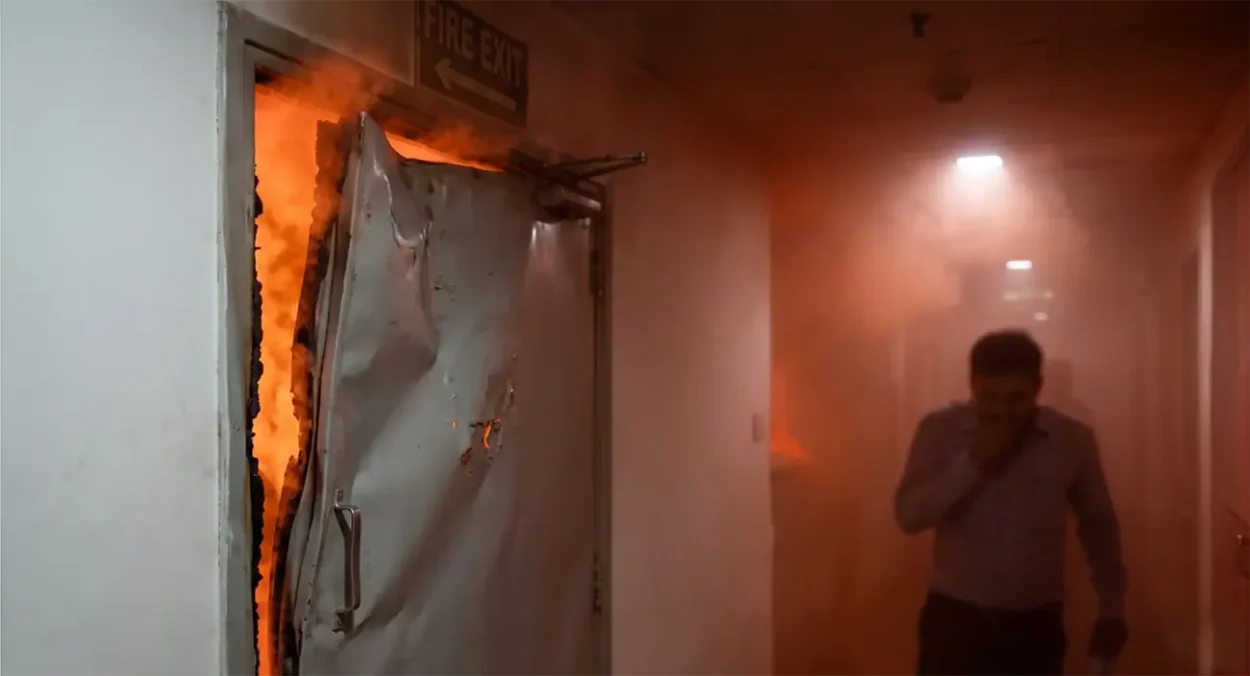
The Indian real estate and industrial infrastructure sectors are experiencing unprecedented growth. However, this rapid vertical expansion brings an urgent need for uncompromising structural safety. Among the most critical components of modern passive fire protection systems are fire rated doors. Yet, a dangerous trend persists: many developers sacrifice safety for short-term cost savings by installing substandard or untested products.
Understanding the full scope of non compliant fire doors India consequences is essential for any modern developer. Failing to meet established standards involves more than just a regulatory violation; it exposes builders to severe fire door legal liability, threatens the financial viability of projects through insurance rejections, and compromises human lives.
Direct Answer Box: What are the main consequences of non-compliant fire doors for builders in India? The consequences of installing non-compliant fire doors in India include criminal and civil legal liability under the National Building Code (NBC) 2016, total rejection of insurance claims following a fire incident, structural failure during evacuations, and severe reputational damage. Non-compliant doors fail to contain smoke and flame, transforming escape routes into fatal traps.
Recent Fire Incidents in India and the Role of Structural Openings
In recent years, catastrophic structural fires across major Indian metropolitan areas—from commercial high-rises in Mumbai to manufacturing units in Delhi NCR and warehouse complexes in Bangalore—have highlighted structural vulnerabilities. Post-incident forensic investigations conducted by fire authorities frequently reveal a common failure point: the compromise of structural openings due to non-compliant or improperly installed doors.
When a fire breaks out, containment is key to survival. Fire safety doors are designed to serve as barriers that isolate fire and toxic gases within a specific zone (compartmentalization), allowing occupants to escape safely via designated exits. When non-compliant doors are used, they warp, fail to latch, or lack proper seals. This allows toxic smoke—the primary cause of fatalities in building fires—to flood escape routes and elevator shafts, rendering emergency evacuation plans useless.
Legal Liability Under BIS & NBC: Navigating the Regulatory Framework
Direct Answer Box: What are the legal requirements for fire doors under Indian regulations? Indian regulations mandate that all fire doors must comply strictly with the IS 3614:2021 standard and the guidelines detailed in the National Building Code (NBC) 2016. Builders who install non-compliant doors face severe fire door legal liability, including prosecution, heavy fines, and the withholding of Occupancy Certificates (OC).
Understanding the Statutory Standards
The regulatory landscape governing structural fire safety in India is clear and legally binding. Developers and contractors must align their projects with two foundational frameworks:
- IS 3614 (Part 1 & Part 2): This Bureau of Indian Standards (BIS) code outlines the rigorous testing methods and performance criteria required for fire doors. It specifies how a door assembly must behave under intense heat, measuring parameters like structural integrity, thermal insulation, and radiation stability. Every valid assembly must carry verifiable traceability back to an approved testing agency.
- National Building Code (NBC) 2016 / 2025: The NBC explicitly dictates the placement, hourly rating, and construction mechanics of fire doors along escape routes, smoke-stop lobbies, and hazardous areas.
The Realities of Fire Door Legal Liability
If a fire incident results in injury or death and a subsequent audit reveals the presence of uncertified doors, the legal fallout for real estate developers, chief safety officers, and contractors can be severe:
- Criminal Negligence: Under the Indian Penal Code (IPC), developers and project managers can be charged with criminal negligence for failing to provide adequate life-safety infrastructure.
- Withholding of Occupancy Certificates (OC): Fire departments across regions like Delhi NCR, Maharashtra, and Karnataka have tightened inspection protocols. Discovering non-certified doors during a final inspection leads to an immediate rejection of the Fire No-Objection Certificate (NOC), delaying project handover indefinitely.
- Financial Penalties and Project Demolition Orders: Local municipal corporations hold the authority to seal non-compliant high-rises or levy daily compounding penalties until the entire structural opening inventory is retrofitted with NBC compliant doors.
Technical Definition Box
- IS 3614 Standards: The official Indian Standard governing the specifications, performance, and testing methodology of fire-resistant door assemblies to ensure structural integrity and stability under extreme thermal stress.
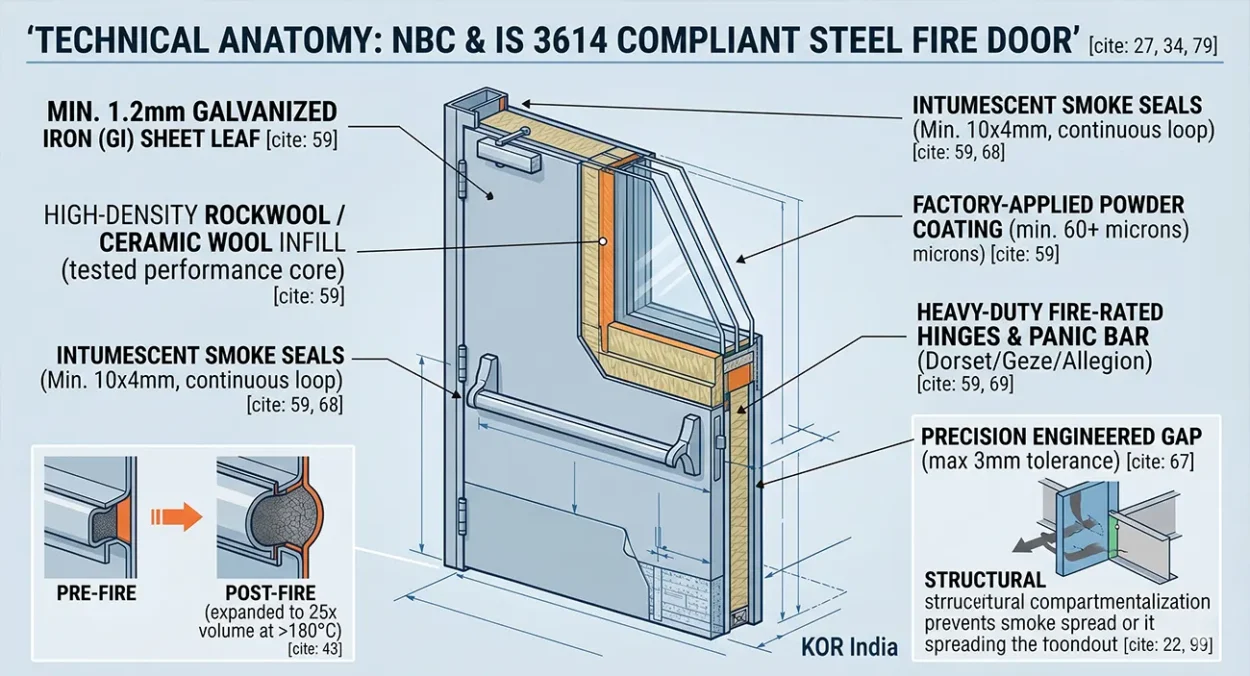
- Intumescent Seals: Specialized chemical strips installed along the perimeter of a fire door frame that expand up to 25 times their original volume when subjected to heat above 180°C, sealing all gaps to prevent the passage of toxic smoke and hot gases.
Insurance Claim Rejection Risks: The Financial Peril of Non-Compliance
Direct Answer Box: Can insurance companies reject claims due to non-compliant fire doors? Yes, insurance companies in India routinely reject multi-crore property damage and business interruption claims if surveyors discover that non-compliant fire doors were installed. Insurance policies depend on strict adherence to fire safety regulations builders India, and non-compliance voids the warranty terms of the policy.
Commercial property insurance policies are binding legal contracts that require the insured party to maintain standard risk-mitigation infrastructure. When a developer or industrial facility manager submits a claim after a major fire, a loss surveyor is dispatched to assess compliance.
If the surveyor discovers that the fire spread rapidly because of uncertified industrial fire doors or that the doors lacked proper fire-rated hardware, the insurer can deny coverage under the “breach of warranty” or “increased risk” clauses. The builder or enterprise is then left to absorb the entire financial burden of asset reconstruction, structural restoration, and third-party liability claims out of pocket.
Human Cost and Corporate Responsibility: Beyond the Balance Sheet
While financial and legal parameters can be quantified, the human cost of a fire is absolute. Corporate Social Responsibility (CSR) and Environmental, Social, and Governance (ESG) criteria require modern builders to prioritize life safety.
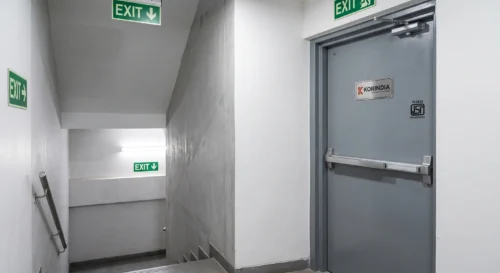
High-density commercial spaces—such as hospitals, IT parks, shopping malls, and academic campuses—require reliable escape routes. Installing substandard doors along fire exits shortchanges occupant safety. When a high-performance steel fire door functions correctly, it provides up to 120 minutes of protection, creating a safe window for emergency services to evacuate the building.
Direct Technical Comparison: Standard Commercial Doors vs. KOR India Compliant Assemblies

To help project managers and developers understand the engineering differences between standard doors and fully certified safety systems, the table below highlights key performance differences:
| Engineering Parameter | Standard Commercial Doors | KOR India Steel Fire Doors |
| Testing & Certification | Untested or self-certified; no verifiable traceability. | Fully compliant with IS 3614; tested at CBRI Roorkee. |
| Base Material Thickness | Sub-1.0mm mild steel or wood prone to rapid thermal degradation. | Minimum 1.2mm Galvanized Iron (GI) sheet for door leaves. |
| Internal Core Infill | Cardboard honeycomb, standard PUF, or empty air cavities. | High-density Rockwool, ceramic wool, or specialized cores. |
| Smoke & Heat Sealing | Standard rubber or PVC weather-stripping (melts rapidly). | Certified Intumescent and smoke seals (min. 10x4mm). |
| Surface Coating | Liquid paint prone to ignition and toxic smoke emission. | High-durability powder coating exceeding 60+ microns. |
| Hardware Integration | Standard architectural hinges and non-rated locks. | Fire-rated panic hardware from premium brands (Dorset, Geze, Allegion). |
The Ultimate Fire Door Compliance Audit: A Step-by-Step Checklist for Builders
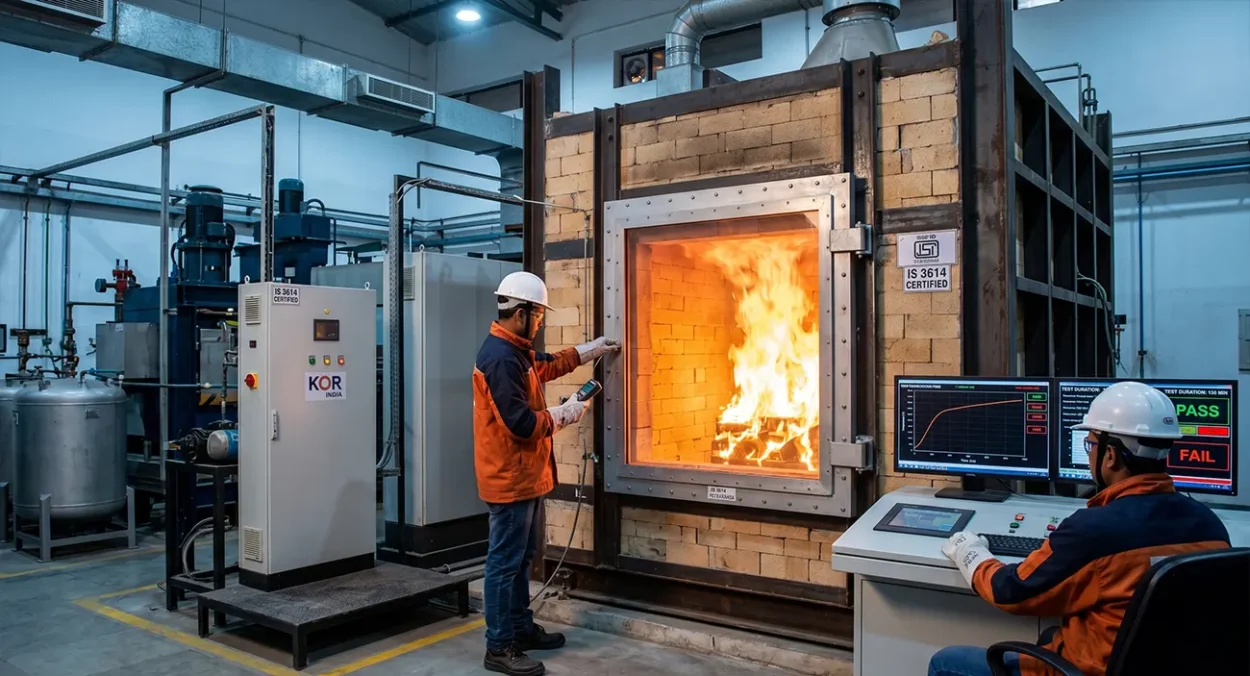
Direct Answer Box: How can a builder verify if their installed fire doors are compliant? Builders can verify compliance by checking for physical ISI markings, reviewing official test reports from accredited labs like CBRI Roorkee, verifying structural dimensions (such as 1.2mm GI leaf thickness), and ensuring the presence of intact, minimum 10x4mm intumescent smoke seals.
If you are currently managing a construction site or auditing an existing commercial facility in regions like the Delhi NCR, Mumbai, or Bangalore, follow this technical procedure to verify compliance:
- Verify Certification Traceability: Demand the Bureau of Indian Standards (BIS) license number and the official test reports from CBRI Roorkee or an NABL-accredited laboratory. Every door must feature a permanent, tamper-proof identification plate.
- Inspect Material Specifications: Ensure the door leaf uses a minimum 1.2mm Galvanized Iron (GI) sheet to guarantee corrosion resistance and structural integrity under Indian climatic conditions.
- Measure Perimeter Clearances: A precise fit is essential. Check that the gap between the door leaf and the frame does not exceed 3mm, which is the precise toleration limit required to preserve fire integrity.
- Examine the Seals: Verify that high-performance intumescent seals (minimum dimensions of 10x4mm) run continuously along the frame profile.
- Evaluate Hardware Performance: Ensure all emergency exit doors feature heavy-duty panic bars, door closers, and hinges sourced from certified hardware partners such as Dorset, Geze, or Allegion.
What a Compliant Upgrade Looks Like: The KOR India Engineering Blueprint
Upgrading your project’s passive fire protection infrastructure requires partnering with an experienced manufacturer. KORINDIA Precision Private Limited, a strategic collaboration with South Korea’s industry leader Hallim Precision Co. Limited (established 1983), delivers high-performance door solutions tailored for demanding industrial and commercial environments.
Operating from a state-of-the-art, highly automated manufacturing facility in the Kasna Industrial Area, Greater Noida, Uttar Pradesh, KOR India provides end-to-end engineering support:
- A Comprehensive Portfolio: From steel fire rated doors and vision panel fire doors for corporate lobbies to specialized clean room doors and lead lined doors for healthcare applications.
- Verified Fire Classifications: Products are engineered and certified for FD 60, FD 90, and FD 120 classifications, offering up to 120 minutes of fire containment.
- Professional Installation and Maintenance: Factory-trained teams handle precision alignment and site fitment, backed by structured Annual Maintenance Contracts (AMC) to ensure long-term readiness.
Protect your business from the consequences of non-compliant infrastructure. Contact the engineering experts at KOR India today to schedule a comprehensive, professional site audit for your project.
Key Takeaways
- Core Product Offering: KOR India manufactures high-performance, IS 3614 certified fire doors designed for Indian conditions.
- Performance Classifications: Available assemblies cover certified FD 60, FD 90, and FD 120 safety intervals.
- Rigorous Testing: All core configurations are fully tested at CBRI Roorkee and NABL laboratories.
- Manufacturing Infrastructure: Precision engineering is centered at the company’s automated facility in Greater Noida, UP, serving major commercial hubs nationwide.
Frequently Asked Questions (FAQs)
The NBC 2016 mandates that all industrial factories partition hazardous manufacturing zones with a minimum of 120-minute fire-rated structural barriers. Escape routes must lead directly to enclosed stairwells or open-air zones via steel fire doors equipped with fire-rated panic bars and automatic self-closing mechanisms to prevent smoke migration.
Buildings within the Delhi NCR must install doors compliant with IS 3614:2021 standards. The Delhi Fire Services require verifiable test certificates from accredited labs like CBRI Roorkee before issuing or renewing a building’s Fire NOC.
Hospitals require a minimum 120-minute fire door (FD 120) for primary escape stairwells, lift lobbies, and ICU boundaries. This provides additional time to safely evacuate non-ambulatory patients who cannot move independently during an emergency.
The price of a BIS-certified steel fire door varies based on dimensions, clear vision panel configurations, and hardware selection. While initial costs are higher than standard unrated commercial doors, investing in certified doors prevents potential legal fines, project delays, and insurance rejections.