
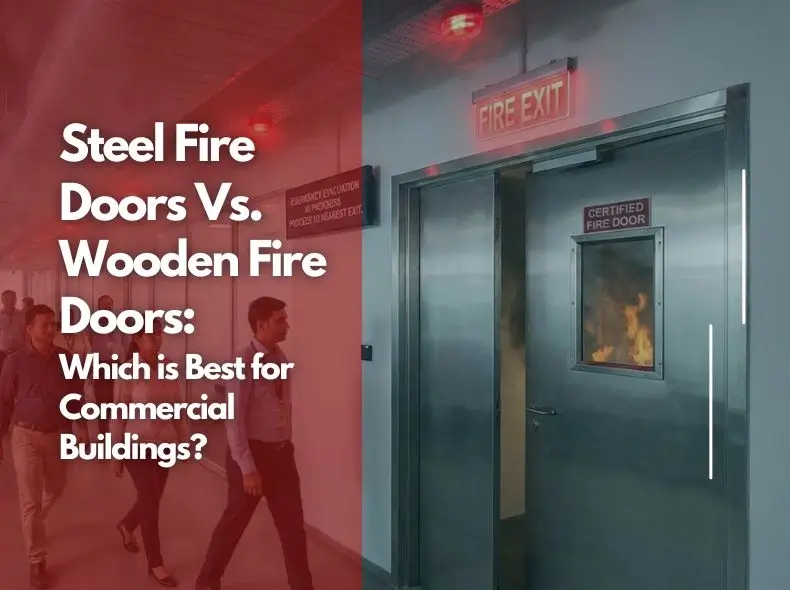
Imagine walking through a bustling commercial complex, offices humming, corridors alive with footfall.
Suddenly, the unthinkable happens: a fire breaks out. What stands between chaos and a safe evacuation?
It’s the doors, specifically those engineered to hold back flames and smoke just long enough for everyone to escape.
In today’s fast-growing urban India, where skyscrapers, malls, and factories rise daily, choosing the right fire doors isn’t optional; it’s a legal and moral imperative.
As buildings get taller and denser, fire safety demands precision. And here’s where the debate heats up: steel fire doors or wooden fire doors?
At KORIndia, we’ve spent years crafting solutions that protect lives and assets across Delhi NCR and beyond.
But which material truly shines for commercial buildings?
Let’s dive in, backed by standards like IS 3614:2021 and real-world insights. By the end, you’ll know exactly what fits your project.
Fire Doors 101: Your Building’s Silent Guardians
Fire doors aren’t ordinary barriers. They’re tested assemblies, door leaf, frame, hardware, seals, that resist fire for a set time, typically 60 to 120 minutes in commercial setups. They block flames, hot gases, and smoke, buying precious minutes for evacuation and firefighter response.
In India, the National Building Code (NBC) and IS 3614:2021 dictate their use. Every fire door must carry BIS certification, proving it withstood furnace tests for integrity and insulation. Whether steel or wood, non-compliance risks fines, shutdowns, or worse, lives lost. Think of it this way: a fire door is like a dam holding back a flood. Failures often stem not from material, but poor installation or skipped maintenance. Now, let’s compare the two contenders head-on.
Steel Fire Doors: Built for Battle
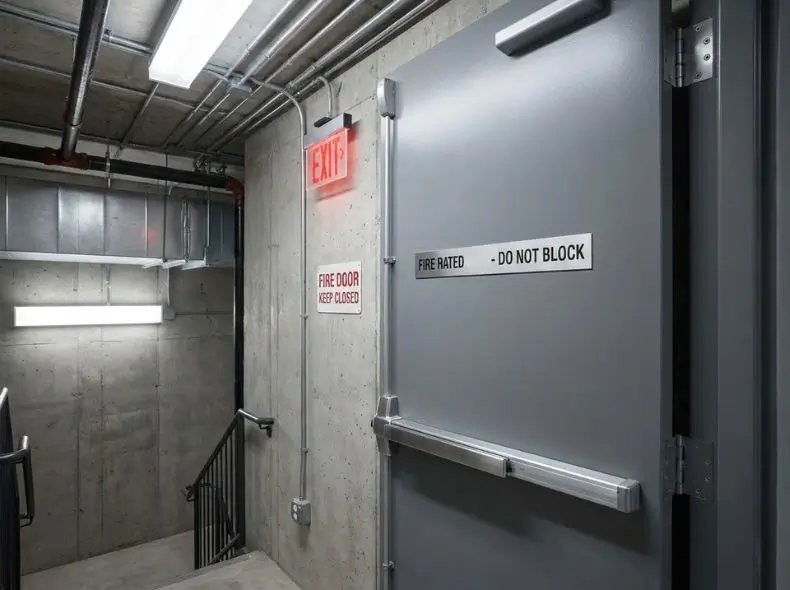
Steel fire doors dominate where toughness counts. Constructed from galvanised steel sheets (typically 1.2–1.6 mm thick) over a fire-retardant core like vermiculite or rockwool, they shrug off impacts that would splinter wood.
Ratings? Easily 120–180 minutes, perfect for basements, stairwells, and plant rooms. They’re moisture-proof, rust-resistant with powder coating, and ideal for humid Indian climates or industrial fire doors in factories. No warping, no termites, just unwavering performance.
At KORIndia, our steel fire doors are CBRI-tested and IS 3614:2021 compliant, with options for vision panels, panic hardware, and custom RAL colors. They’re the go-to for high-traffic commercial hubs like IT parks in Greater Noida.
But strength has trade-offs. They’re heavier (needing sturdy frames) and have that industrial vibe, though modern finishes make them versatile.
Wooden Fire Doors: Elegance Meets Essentials
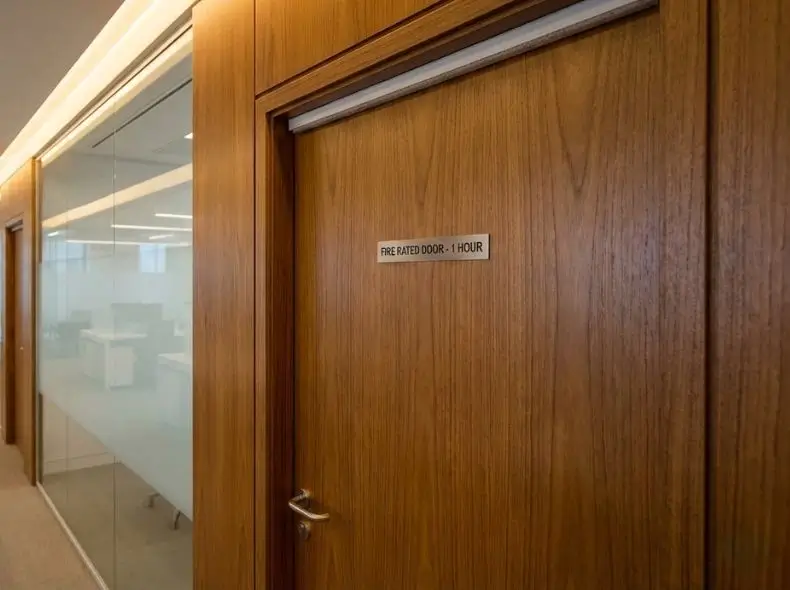
Don’t dismiss wood yet. Today’s wooden fire doors use hardwood or engineered cores (particleboard with gypsum) infused with fire retardants, plus intumescent strips that swell to seal gaps when heated.
They hit 60–90 minutes reliably, sufficient for office corridors or hotel lobbies. Aesthetics win big: veneers mimic oak or teak, blending seamlessly with interiors. Lighter weight eases installation, and they insulate sound and heat better.
Yet, challenges lurk. Humidity swells them; impacts dent; maintenance demands annual checks on seals and paint. In high-abuse zones, they falter faster than steel. Still, for aesthetic-driven commercial spaces, they’re a smart pick if rated right.
KORIndia offers wooden fire resistant doors too, fully certified, but we advise them selectively, pairing with steel where risks peak.
Head-to-Head: Steel vs. Wooden Fire Doors
No one-size-fits-all. Here’s a breakdown for commercial buildings, drawing from standards and field experience.
| Aspect | Steel Fire Doors | Wooden Fire Doors |
| Fire Rating | 120–180 mins common; excels in high-risk | 60–90 mins typical; good for moderate-risk |
| Durability | Superior: impact/moisture/termite-proof | Moderate: prone to warp, dent, degrade |
| Maintenance | Low: wipe clean, check hardware yearly | High: repaint, reseal often |
| Aesthetics | Industrial chic; powder-coated options | Warm, customizable veneers |
| Cost (Initial/Lifecycle) | Higher upfront; lower long-term | Lower start; rises with upkeep |
| Weight & Install | Heavy; needs reinforced frames | Lighter; simpler fit |
| Best For | Exits, basements, and industrial fire doors | Interiors, hotels, offices |
Transitioning smoothly, steel pulls ahead in 70% of commercial scenarios per industry trends, durability trumps all when lives hang in balance.
Fire Ratings Deep Dive: What the Numbers Mean
Fire ratings aren’t guesses, they’re lab-proven. IS 3614:2021 tests doors in furnaces mimicking real fires: stability (no collapse), integrity (no cracks/flames), insulation (limited heat transfer).
Steel hits E120 or E180 effortlessly; wood caps at E90 without bulk. For commercial buildings over 15m tall (per NBC), 120-min doors are mandatory in escape routes. Smoke control? Both can add cold smoke seals, but steel’s rigidity keeps gaps minimal longer.
Rhetorical question: Would you bet on a 60-min door for a 24/7 data center? Exactly, steel fire safety doors ensure compliance and peace of mind.
Durability in the Real World
Commercial buildings endure daily grind. Steel fire doors laugh at trolleys ramming corridors or monsoon leaks, galvanized cores prevent rust, unlike wood’s swelling nightmare.
One analogy: steel is like a tank; wood, a sturdy fence. Both hold, but tanks endure sieges. In Delhi NCR’s dust and humidity, steel’s edge shines, fewer callbacks for KORIndia clients.
Maintenance tip: For steel, annual lube on hinges; wood needs biannual full audits. Skip it, and ratings drop, fire doors become sieves.
Aesthetics and Integration
Wood wins hearts in client-facing areas. Picture a luxury office: teak-veneered fire resistant doors fool the eye while protecting. Custom laminates match wardrobes seamlessly.
Steel? Once clunky, now sleek with woodgrain powder coats or glass inserts. For back-of-house, it’s perfect, no compromises on safety for style. Balance both: steel for cores, wood for facades.
Cost Breakdown: Beyond the Sticker Price
Upfront, a 60-min wooden door might cost ₹15, 000–25, 000; steel ₹20, 000–35, 000 (per leaf, standard size). But factor lifecycle: wood’s refinishing adds ₹5, 000 yearly; steel lasts 20+ years untouched.
ROI favors steel in industrial fire doors, fewer disruptions, insurance perks. KORIndia’s bulk pricing and warranties tip scales further for Delhi NCR projects.
IS 3614:2021 Compliance Essentials
India’s gold standard: IS 3614:2021 mandates third-party testing (CBRI Bhopal ideal), labeling, and install per NBC Part 4. Covers steel/wood alike, but steel’s consistency aces audits. Global sync: UL10C, BS476 align, vital for MNCs. Insist on certificates, fakes abound. KORIndia supplies full docs, easing approvals.
Steel Fire Doors Shine in These Spots
- High-rise exits/staircases: Unmatched reliability under load.
- Basements/plant rooms: Moisture-proof fortresses.
- Industrial setups: Factories, warehouses withstand forklifts.
- Hospitals/airports: 24/7 abuse, zero failures.
Steel fire doors here prevent disasters, per case studies.
Wooden Fire Doors’ Sweet Spots
- Office corridors: Aesthetic + adequate rating.
- Hotels/lobbies: Guest-pleasing looks.
- Conference rooms: Soundproof bonus.
Limit to low-abuse, dry zones, pair with steel elsewhere.
Installation and Maintenance Mastery
Wrong install kills ratings: gaps over 3mm? Fail. Use certified fitters; steel needs level frames, wood precise gaps.
Maintenance: Visual checks quarterly, close fully? Seals intact? Hardware smooth? Log it for audits. KORIndia offers service contracts in Delhi NCR.
Why KORIndia for Your Fire Doors?
As a leading fire door manufacturers in India, KORIndia crafts steel fire doors that exceed IS 3614:2021, CBRI-tested, customizable, factory-direct from Greater Noida. We’ve equipped malls, IT towers, and factories, blending safety with savings.
Our edge: In-house testing, quick Delhi NCR delivery, expert consultation. No middlemen, just quality fire safety doors tailored to you.
Ready to upgrade? Contact KORIndia today for a free site audit and quote. Protect what matters, call now!
FAQs: Steel Fire Doors vs. Wooden Fire Doors
Which offers better fire protection, steel or wooden fire doors?
Steel fire doors typically achieve higher ratings (120+ mins) and superior durability, ideal for commercial high-risk areas. Wooden suffices for interiors at 60–90 mins if certified.
Can wooden fire doors handle industrial environments?
Rarely, moisture and impacts degrade them fast. Opt for industrial fire doors in steel for factories or warehouses.
How do I ensure IS 3614:2021 compliance?
Demand BIS marks, CBRI reports, and pro install. KORIndia’s steel fire doors come fully documented.
What’s the maintenance difference?
Steel: Minimal, yearly checks. Wooden: Frequent seals/paint to avoid rating loss.
Are steel fire doors customizable for offices?
Yes, colors, glazing, and wood-look finishes make them aesthetic without compromising strength.