What are Clean Room Doors?
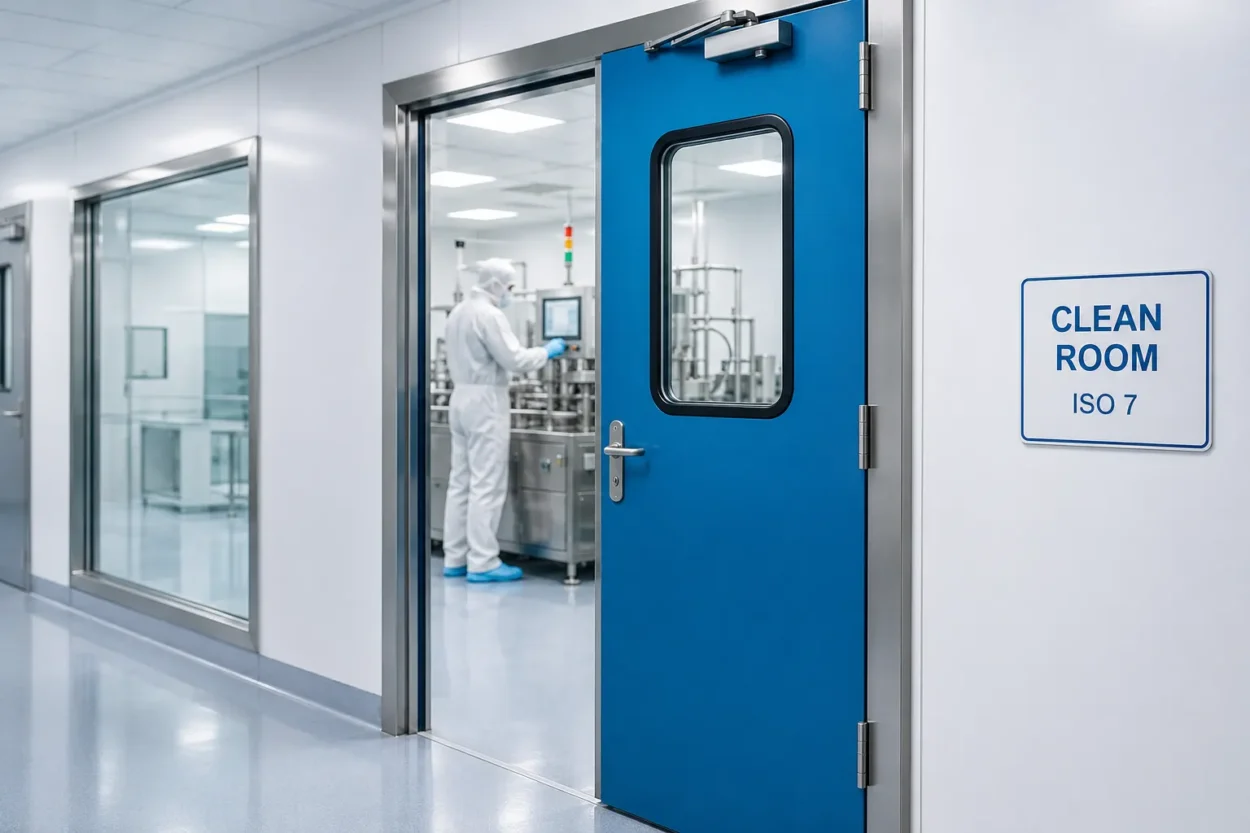
Clean room doors India are high-performance, precision-engineered access systems designed specifically for controlled environments like pharmaceutical plants, biotechnology labs, and microelectronics facilities. Unlike standard commercial entryways, these specialized pharmaceutical facility doors guarantee absolute airtight sealing, maintain strict pressure differentials, and feature completely flush surfaces to prevent particle accumulation. Choosing a verified GMP compliant doors manufacturer India ensures your facility satisfies rigorous international regulatory audits, including WHO-GMP, USFDA, and ISO standards.
Introduction: The High-Stakes World of Controlled Environments
In pharmaceutical manufacturing and advanced biotechnology, a single microscopic airborne particle, microbe, or cross-contaminant can compromise an entire production batch, costing millions of rupees and halting vital supply chains. Contamination control is not just a operational preference—it is a strict regulatory and safety mandate.
Within these ultra-clean ecosystems, every architectural component acts as a defensive barrier. Among these, entryways represent the most volatile variable. Every time a door opens, closes, or sits idle, it directly impacts airflow dynamics, pressure containment, and particulate levels.
Standard industrial doors cannot withstand the rigorous environmental demands of a sterile production facility. This comprehensive technical guide analyzes why modern pharmaceutical setups require high-performance, specialized containment systems, and establishes a clear blueprint for engineering heads, facility planners, and plant managers to select the optimal solutions.
What Makes a Clean Room Environment Critical?
A cleanroom is an engineered space designed to maintain extremely low concentrations of airborne particles, including dust, airborne microbes, aerosol particles, and chemical vapors. To sustain these pristine conditions, every piece of infrastructure must be non-porous, non-shedding, and completely sealed.
The Danger of Micro-Fissures and Cavities
Standard commercial or hollow metal doors feature internal cavities, exposed joints, and visible mechanical fasteners. In a regular office or commercial space, these design elements go unnoticed. However, in a sterile manufacturing area, these microscopic crevices become breeding grounds for bacteria, fungi, and particulate matter. Regular sanitization routines cannot penetrate these hidden voids, turning standard doors into active biohazards that compromise product purity.
Airborne Cross-Contamination & Product Integrity
Pharmaceutical manufacturing involves handling active pharmaceutical ingredients (APIs), biological cultures, and potent sterile compounds. Cross-contamination between different manufacturing blocks—such as moving from an API synthesis zone to a sterile formulation area—must be prevented. Specialized access solutions act as physical and pressure-driven airlocks, preventing air from escaping or entering sensitive zones uncontrollably.
Regulatory Framework: GMP & ISO Standards for Clean Room Doors
To operate legally and supply international markets, pharmaceutical plants in India must comply with strict national and global regulatory frameworks. The design, installation, and operation of entry systems are directly evaluated during facility audits.
WHO-GMP and USFDA Mandates
Good Manufacturing Practices (GMP) require that all surfaces within a clean room be smooth, impervious, and free from cracks or open joints. Furthermore, they must withstand continuous exposure to aggressive chemical cleaning agents and gaseous decontamination cycles (such as vaporized hydrogen peroxide, or VHP) without corroding or degrading. When evaluating a GMP compliant doors manufacturer India, facility planners must verify that the door leaf, frame, and hardware interface form a perfectly flush, seamless transition that complies with these rigorous guidelines.
ISO 14644 Air Cleanliness Classifications
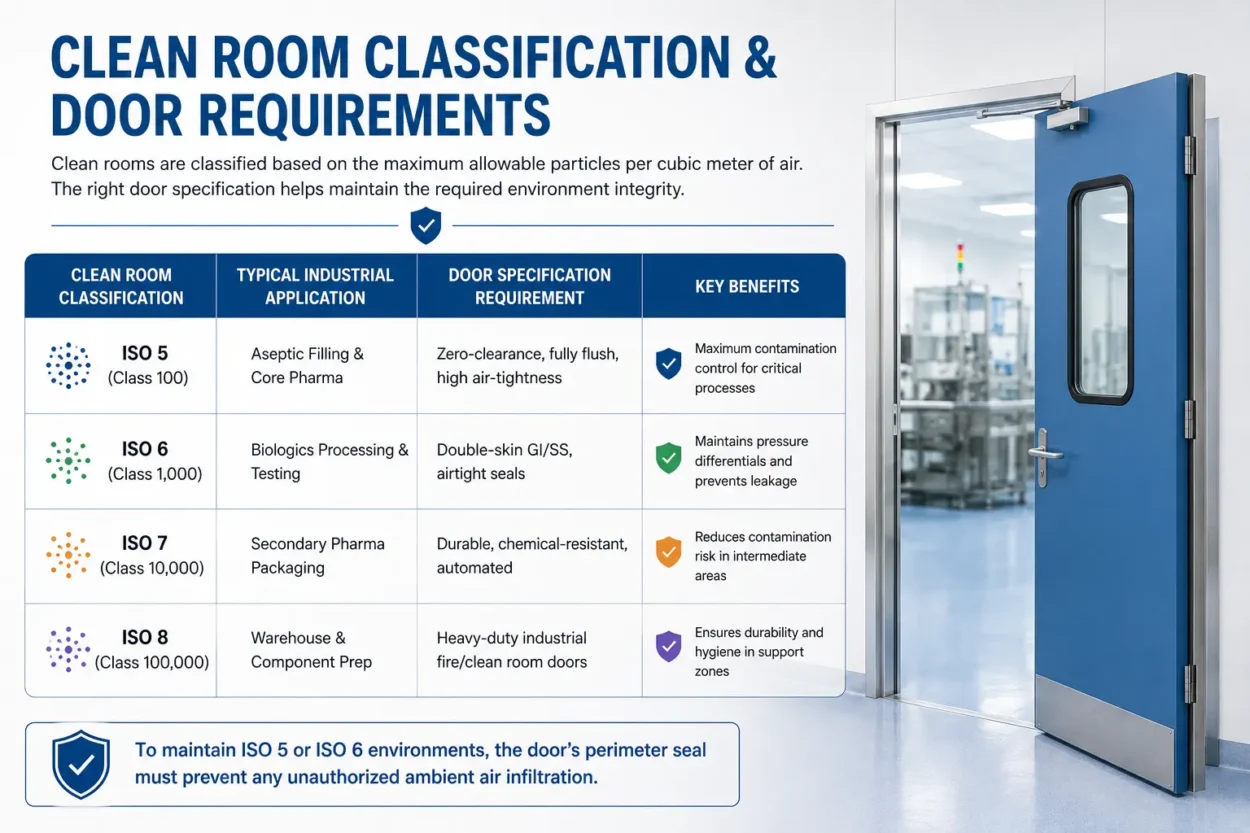
Clean rooms are classified from ISO 1 to ISO 9 based on the maximum allowable concentration of particles per cubic meter of air.
| Clean Room Classification | Typical Industrial Application | Door Specification Requirement |
| ISO 5 (Class 100) | Aseptic Filling & Core Pharma | Zero-clearance, fully flush, high air-tightness |
| ISO 6 (Class 1,000) | Biologics Processing & Testing | Double-skin GI/SS, airtight seals |
| ISO 7 (Class 10,000) | Secondary Pharma Packaging | Durable, chemical-resistant, automated |
| ISO 8 (Class 100,000) | Warehouse & Component Prep | Heavy-duty industrial fire/clean room doors |
To maintain an ISO 5 or ISO 6 environment, the integrity of the door’s perimeter seal must prevent any unauthorized ambient air infiltration.
Key Technical Specifications of High-Performance Clean Room Doors
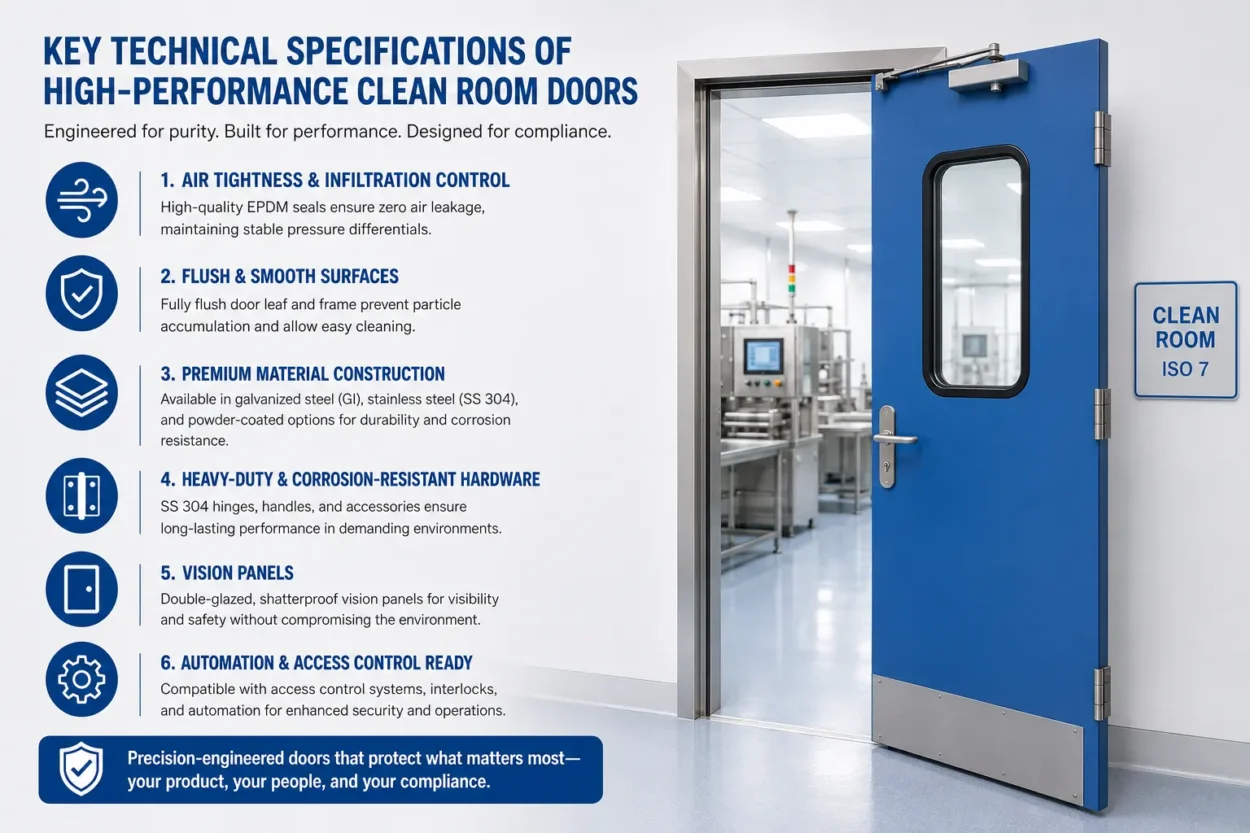
When evaluating premium pharmaceutical facility doors, technical decision-makers must look beyond basic dimensions. The following architectural and structural specifications dictate long-term operational success:
1. Air Tightness and Intelligent Infiltration Control
Airtightness prevents unconditioned, contaminated air from bypassing the cleanroom’s filtration systems. True clean room systems utilize specialized, heavy-duty perimeter gaskets and bottom drop-seals. When the door closes, these mechanics automatically deploy to create a continuous, airtight seal against the floor and frame, minimizing air leakage and energy loss from HVAC systems.
2. Maintaining Pressure Differentials
To keep contaminants out of sensitive areas, cleanrooms rely on pressure cascades. High-purity zones are kept at a higher or lower pressure relative to surrounding rooms.
$$ \Delta P = P_{\text{cleanroom}} – P_{\text{corridor}} $$
Typically, a constant positive pressure differential ($\Delta P$) of 10 to 15 Pascals (Pa) is maintained to ensure that when a door is opened, clean air flows out, preventing dirty air from rushing in. Clean room doors India must be strong enough to withstand continuous pressure differentials without bending, bowing, or vibrating.
3. Advanced Material Science and Surface Engineering
The base materials used in door construction determine how well they withstand daily industrial wear and intensive cleaning routines:
- Galvanized Iron (GI) Steel: Utilizing a minimum sheet thickness of 1.2mm for door leaves and frames provides excellent structural integrity. The steel must receive a high-durability powder coating of over 60 microns to create a smooth, scratch-resistant surface that withstands chemical exposure.
- Stainless Steel (SS 304 / SS 316): For environments exposed to aggressive acids, moisture, or heavy sanitization, high-grade Stainless Steel provides maximum corrosion resistance and prevents rust formation.
[Pure Core Infill: Honeycomb / Rockwool / Polyurethane]
│
▼
[Seamless Outer Shell: 1.2mm GI Steel or Grade 304/316 Stainless Steel]
│
▼
[Surface Treatment: 60+ Micron Anti-Microbial Powder Coating]
4. Fully Flush Vision Panels and Heavy-Duty Integration
Safety and visibility require incorporating vision windows into the door design. However, traditional window lips create ledges where dust can settle. Clean room entryways use double-glazed, toughened glass vision panels that sit perfectly flush with both sides of the door leaf. This design provides visibility while maintaining a smooth, easily cleanable surface.
Engineered Excellence: KorIndia Clean Room Door Features
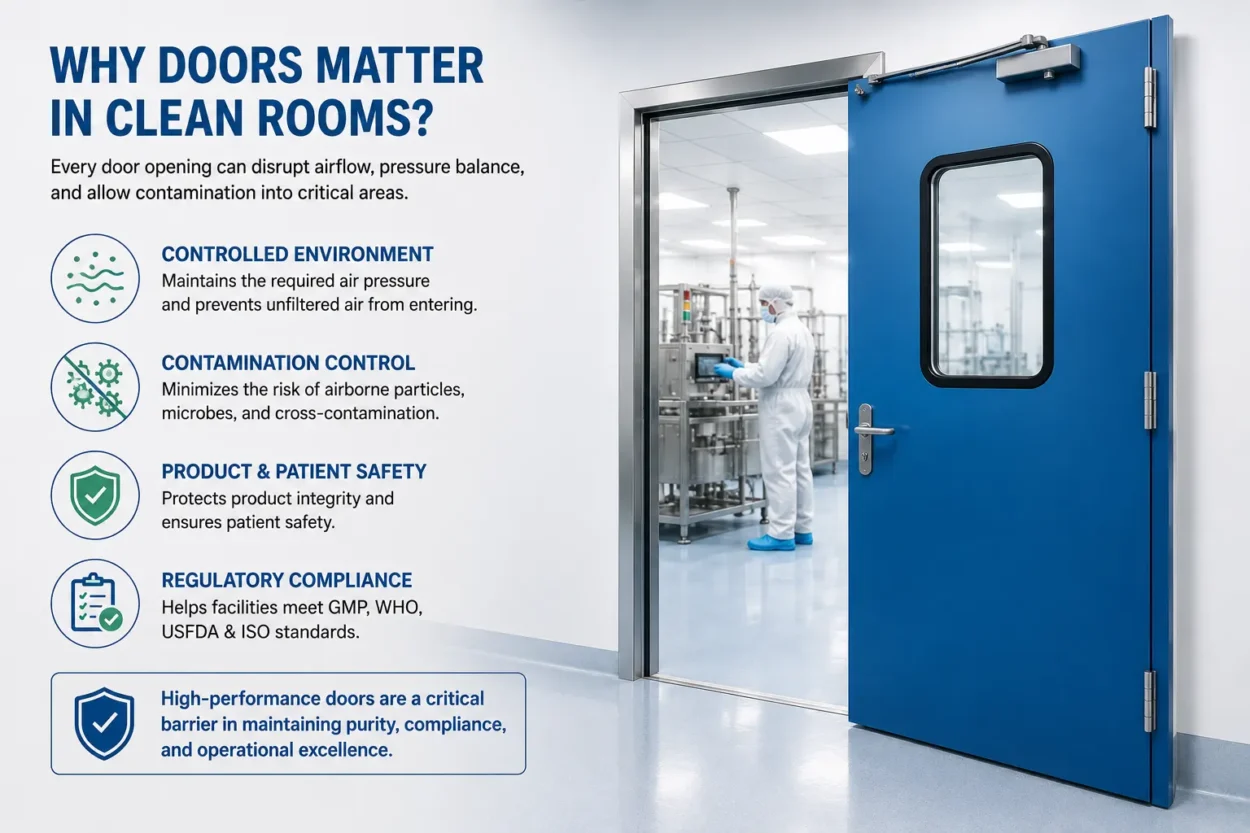
As a leading specialized provider, KORINDIA Precision Private Limited combines global engineering standards with deep localized manufacturing expertise to deliver high-performance clean room door systems. Born from a strategic collaboration with Hallim Precision Co. Limited (South Korea), an industry pioneer since 1983, our products are engineered specifically for demanding industrial applications.
1. Fully Flush Surface Engineering
KOR India’s clean room doors feature a completely smooth design. The door frame and leaf fit together seamlessly with no visible joints, fasteners, or overlapping edges. This prevents dirt build-up and makes daily wipe-downs fast and effective.
2. Robust Structural Infill & Multi-Layer Insulation
Our doors are built using high-quality 1.2mm Galvanized Iron (GI) steel or premium Stainless Steel sheets. They feature high-density infill materials like specialized paper honeycomb, rockwool, or polyurethane foam. This combination provides excellent structural rigidity, flat surfaces, and reliable acoustic insulation to damp plant machinery noise.
3. Integrated Automation and Access Control Systems
Modern pharmaceutical production relies on automated workflows. KOR India systems integrate smoothly with automated building management systems (BMS), contactless magic switches, proximity sensors, and secure biometric readers. Our advanced interlocking electronic control systems prevent dual-door opening cycles in airlocks, maintaining pressure balances and preventing cross-contamination.
4. High-Performance Hardware and Seal Integrity
A door is only as reliable as its hardware components. KOR India partners with trusted international brands like Dorset, Geze, and Allegion to provide durable, smooth-operating hardware. Our heavy-duty stainless steel hinges sit flush within the frame, and non-shedding EPDM gaskets resist chemical sanitizers while maintaining a tight seal over millions of cycles.
Critical Installation Considerations for Pharma Plants
Even a premium clean room door can fail if it is improperly installed. Achieving high performance requires precise structural alignment and professional execution:
- Precise Structural Clearance Control: Factory-trained installation teams must maintain consistent 3mm clearances between the door leaf and the frame profile. This alignment guarantees smooth operation and uniform compression of the airtight perimeter gaskets.
- Perfect Leveling and Plumb Alignment: If a frame is slightly out of alignment, the door can drift or sag. This can ruin the air seals and cause automated entryways to malfunction.
- Seamless Cleanroom Grade Sealing: All joints between the door frame and the wall panels must be sealed with professional-grade, non-sagging, anti-fungal silicone sealants to eliminate any air leaks.
- Comprehensive On-Site Audits and Support: KOR India provides end-to-end support, from initial site audits to customized sizing and professional installation by our factory-trained teams.
Certification Requirements & Validating Quality
When prepping your facility for critical international health and regulatory inspections, having traceable, certified components is essential.
Material Test Certificates (MTC)
Every single door batch must be accompanied by certified documentation verifying the steel grade, zinc coating thickness, and powder coating durability.
Fire Resistance Compliance Integration
Many pharmaceutical zones store volatile chemicals or alcohol-based solvents, making fire safety a primary concern. KOR India specializes in combining cleanroom hygiene with robust fire protection. Our products are fully tested at CBRI Roorkee and NABL-accredited laboratories, and comply with IS 3614:2021 and NBC 2016 building standards. We provide certified clean room doors with verified FD 60, FD 90, and FD 120 fire-resistance ratings to keep your facility protected and fully compliant.
Conclusion: Investing in Long-Term Compliance and Plant Security
Selecting specialized access solutions for pharmaceutical and clean room environments goes beyond simple procurement—it is a critical investment in contamination control, regulatory compliance, and operational efficiency. Choosing certified, high-quality products helps prevent contamination risks, avoid expensive regulatory delays, and keep your production lines running smoothly.
Partner with KORINDIA Precision Private Limited, the trusted industrial manufacturing expert based in Greater Noida, UP, supplying high-performance solutions across Delhi NCR, Mumbai, and Bangalore. Contact our technical engineering team today to schedule an expert site audit and secure high-performance containment systems tailored to your facility’s exact needs.
Frequently Asked Questions
Standard commercial doors feature open joints, crevices, and internal cavities that easily trap dust and moisture, creating breeding grounds for bacterial growth. They also degrade when exposed to the harsh chemical disinfectants used in pharmaceutical clean rooms, and lack the advanced gaskets needed to maintain critical air pressure differentials.
A GMP compliant door is designed to meet strict Good Manufacturing Practices. It features flat, smooth surfaces where the frame, glass, and leaf fit together seamlessly without any visible joints or ledges. This design prevents particle accumulation and allows the door to withstand continuous cleaning and decontamination cycles.
KOR India doors are built with high-quality, heavy-duty GI steel frames that resist warping under high pressure. They feature specialized EPDM perimeter gaskets and heavy-duty automatic bottom drop-seals that minimize air leakage, helping your HVAC system easily maintain positive or negative pressure balances.
Yes. KOR India manufactures specialized hybrid doors that combine clean room hygiene with certified fire protection. Our steel doors are tested at CBRI Roorkee and fully comply with IS 3614 standards, providing certified protection ranging from FD 60 to FD 120 minutes.
The preferred materials are high-quality Galvanized Iron (GI) steel (minimum 1.2mm thickness) finished with an anti-microbial powder coating (60+ microns), or high-grade Stainless Steel (SS 304 or SS 316) for environments exposed to moisture or aggressive chemical cleaning agents.