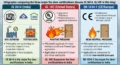
In industrial infrastructure and modern commercial architecture, passive fire protection systems are fundamental to safeguarding lives and structural assets. Among these systems, fire rated doors serve as primary structural barriers, isolating hazardous zones, preventing smoke migration, and securing critical evacuation pathways. However, selecting and specifying the correct fire door assembly requires a precise understanding of national statutory mandates, testing frameworks, and structural engineering certifications.
For architects, structural engineers, and compliance officers, navigating the overlap between Indian Standards (IS), the National Building Code (NBC), and testing lab validations can be complex. This comprehensive technical guide decodes fire door ratings India, breaking down the mechanics of the IS 3614 fire door standard, NBC directives, and the critical role played by Central Building Research Institute (CBRI) certified assets.What is a fire-rated door? A fire-rated door is a heavily engineered structural life-safety assembly consisting of a door leaf, frame, hardware, and intumescent seals designed to withstand fire, radiant heat, and toxic gases for a specified duration (60, 90, or 120 minutes) to maintain compartmentation and clear egress corridors.
Understanding Fire Door Ratings India: The Core Framework
Direct Answer: How are Fire Doors Classified in India?
Fire door ratings in India classify structural door assemblies based on their ability to resist fire under laboratory-controlled test conditions. These classifications are designated by time intervals—primarily FD 60, FD 90, and FD 120—representing 60, 90, and 120 minutes of verified structural resistance against integrity loss, thermal transmission, and structural collapse.
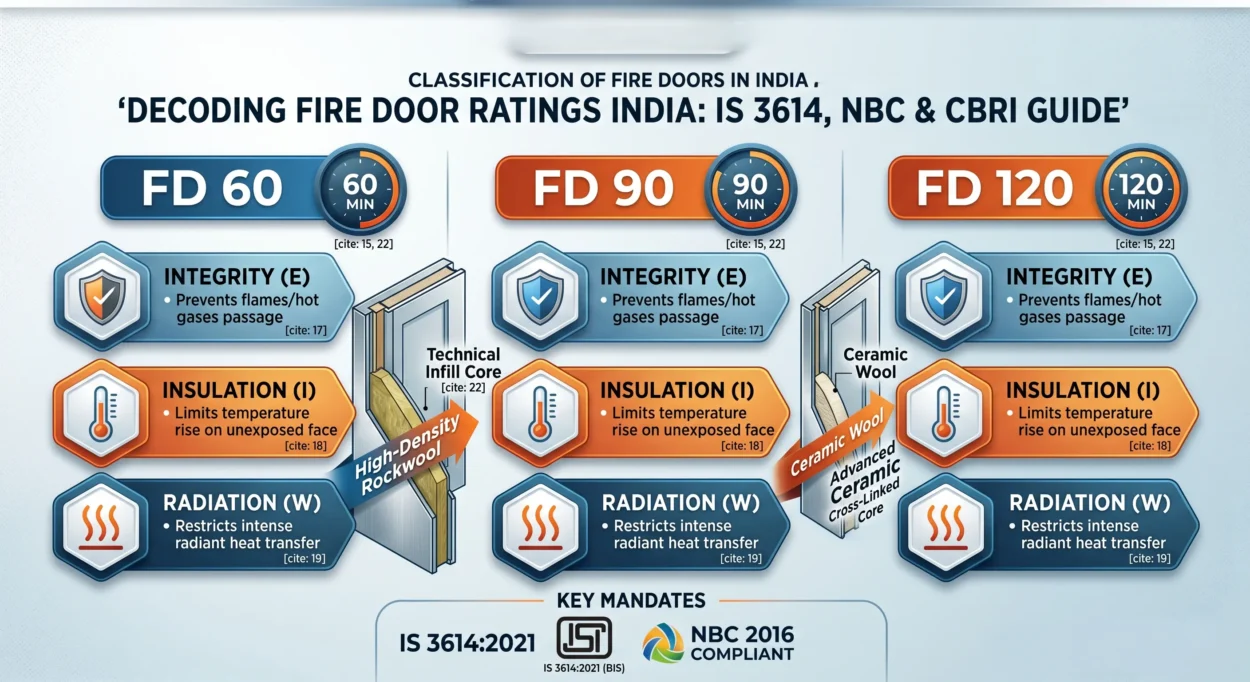
To implement a reliable passive fire strategy, structural engineers must evaluate fire resistance across three engineering metrics:
- Integrity (E): The capability of the door assembly to resist structural failure, preventing the physical passage of flames or hot gases through gaps or structural cracks.
- Insulation (I): The metric measuring the door leaf’s capacity to limit temperature rise on the unexposed face, preventing the spontaneous auto-ignition of combustible materials stored near the non-fire side.
- Radiation (W): The ability of the structural core to limit the transmission of intense radiant heat into critical escape corridors.
Technical Performance Standards For Fire Door Classifications
The table below details the technical performance criteria across typical commercial and industrial infrastructure classifications:
| Fire Rating Classification | Minimum Integrity Duration | Minimum Insulation Duration | Typical Engineering Infill Core | Structural Applications |
| FD 60 | 60 Minutes | 60 Minutes | High-Density Rockwool / Honeycomb | Commercial lobbies, server rooms, hotel guest rooms |
| FD 90 | 90 Minutes | 90 Minutes | Ceramic Wool / Dense Rockwool | High-occupancy industrial corridors, institutional main stairwells |
| FD 120 | 120 Minutes | 120 Minutes | Advanced Ceramic Cross-Linked Core | Electrical substations, data centers, hazardous manufacturing zones |
Demystifying the IS 3614 Fire Door Standard (Part 1 & Part 2)
Direct Answer: What is the IS 3614 Standard?
The IS 3614 fire door standard is the definitive framework governing the manufacturing, dimensions, performance criteria, and rigorous testing methodologies for fire-resistant doors in India. Updated to integrate modern structural engineering requirements under IS 3614:2021, it ensures assemblies maintain mechanical integrity under extreme thermodynamic loads.
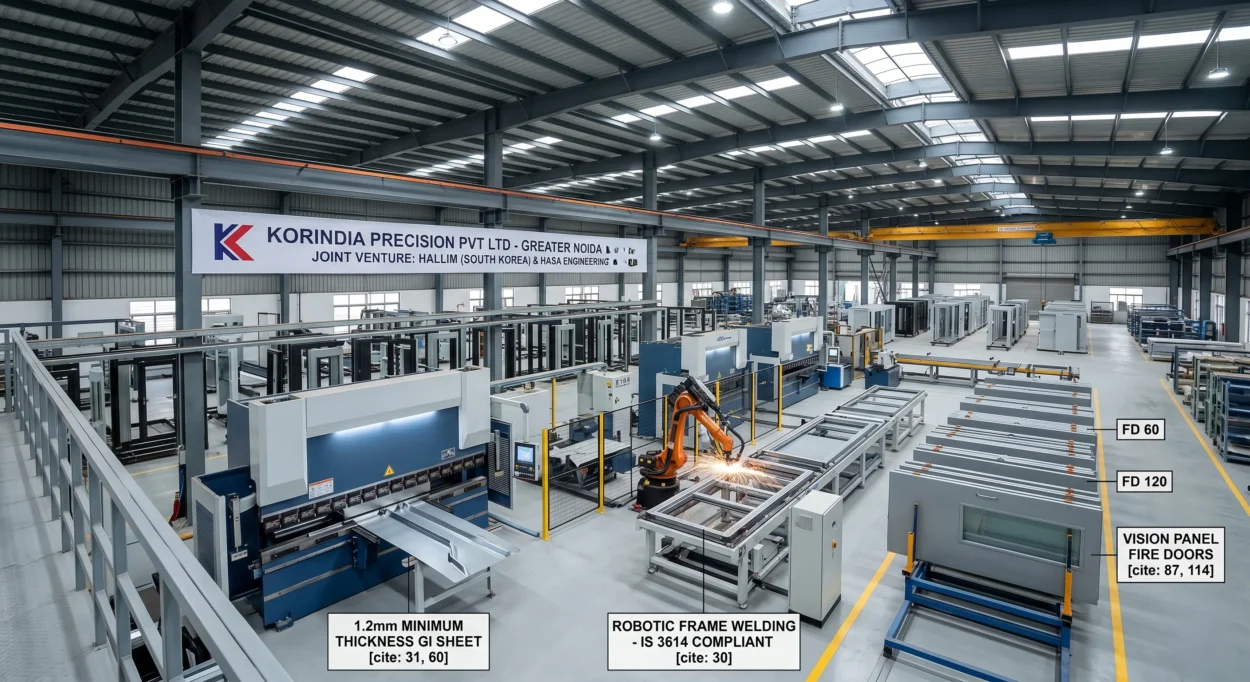
IS 3614 Standards Definition: The regulatory guidelines established by the Bureau of Indian Standards (BIS) detailing material specifications (such as a minimum 1.2mm Galvanized Iron sheet for door leaves) and performance tests required to achieve formal ISI-marked safety certification.
Detailed Breakdown of IS 3614 Components
When evaluating fire safety doors, compliance officers must look for dual adherence to both parts of the standard:
- IS 3614 Part 1 (Material & Structural Configuration): Outlines the structural requirements of the frame and leaf. For steel fire doors, it specifies raw material parameters, emphasizing corrosion-resistant Galvanized Iron (GI) steel sheets with a minimum thickness of 1.2mm for leaves to withstand physical stress and structural twisting.
- IS 3614 Part 2 (Thermodynamic Testing Protocols): Details how prototypes must behave inside specialized furnace tests. The complete structural setup—comprising the frame, hinges, panic hardware, locksets, and door closures—is subjected to a standardized heating curve to verify that mechanical failure or burn-through does not occur prematurely.
National Building Code (NBC) Requirements for Industrial & Commercial Infrastructure
Direct Answer: What are the NBC Fire Door Mandates?
The National Building Code (NBC 2016 and the updated NBC 2025 updates) mandates the strategic deployment of certified fire resistant doors at all critical exit points, refuge areas, elevator shafts, and horizontal exit compartments. These regulations strictly forbid unrated doors along designated emergency escape routes to preserve life-safety margins.
For high-density municipal hubs like Delhi NCR, Mumbai, and Bangalore, local fire authorities enforce NBC compliance thoroughly during structural audits. Key rules include:
- Compartmentation Strategy: Large commercial complexes and manufacturing plants must be partitioned into specific fire zones using industrial fire doors. This limits a fire outbreak to its zone of origin, protecting surrounding infrastructure.
- Escape Route Isolation: Staircases serving high-rise commercial structures must be sealed with a minimum of FD 120 steel fire doors to prevent smoke and heat from blocking the evacuation process.
- Conversational Compliance Query:What are the requirements for fire doors in Delhi NCR? In the Delhi National Capital Region, the Delhi Fire Services (DFS) aligns its building bye-laws with NBC 2016. Any new factory or high-rise asset requires verifiable, BIS-licensed, ISI-marked structural assemblies before a Fire No-Objection Certificate (NOC) can be issued.
The Critical Role of CBRI Certified Fire Doors
Direct Answer: Why is CBRI Certification Essential?
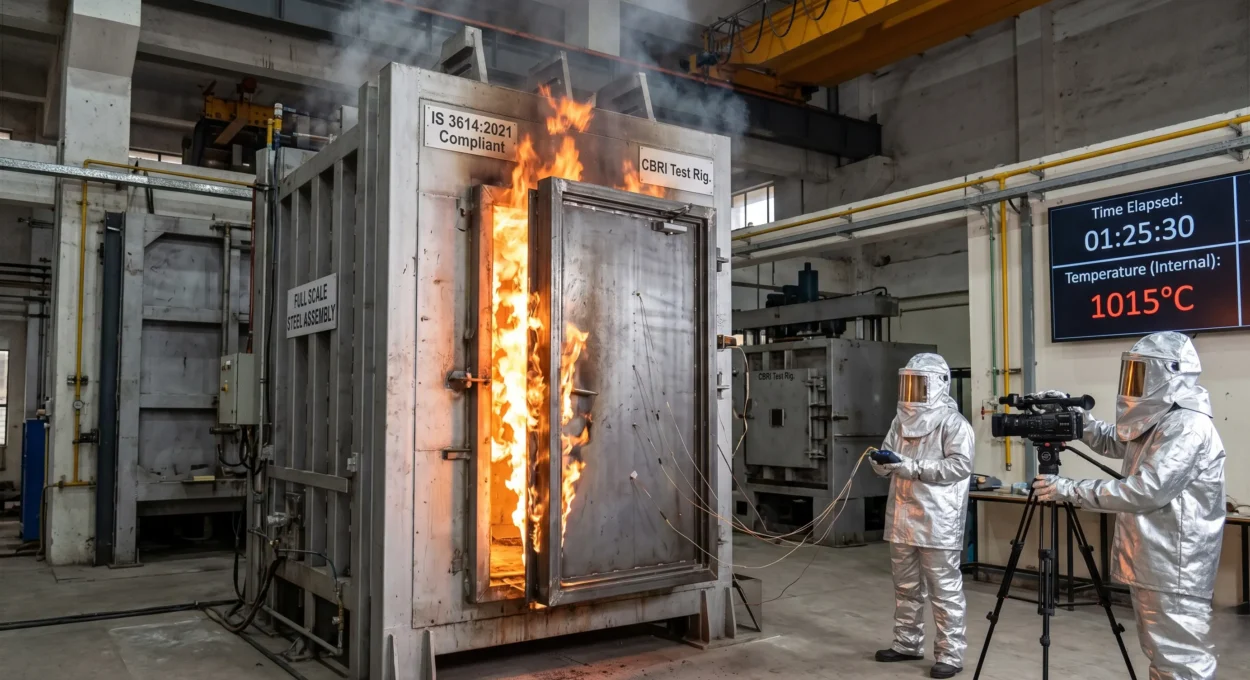
CBRI certified fire doors provide structural and chemical proof that a manufacturer’s design has successfully passed full-scale fire destructive testing. The Central Building Research Institute (CBRI) in Roorkee is India’s premier NABL-accredited fire research laboratory, validating passive fire materials under extreme thermal stress.
To secure valid certification, a production line prototype must undergo standard testing procedures at CBRI Roorkee:
[Prototype Selection] ──> [Furnace Exposure (Up to 1000°C+)] ──> [Pressure/Deflection Testing] ──> [Certification Issuance]
- Real-World Furnace Testing: The full assembly is mounted onto a vertical testing furnace. The internal temperature is escalated past $1000^\circ\text{C}$ to replicate a severe flashover.
- Mechanical Integrity Evaluation: Technicians monitor structural deflection. The door must not warp past predefined limits, and gap gauges must not pass through the leaf boundaries, ensuring toxic smoke is contained.
- Verification Traceability: Specifying CBRI tested fire doors ensures your procurement pipeline is protected by third-party testing reports, shielding developers from legal risks during post-incident investigations.
Technical Comparison: KOR India Fire Rated Doors vs. Standard Commercial Doors
To understand why specialized engineering matters, look at how KOR India fire rated doors compare against typical commercial-grade doors:
Intumescent Seals Definition: Specialized chemical strips inset into the frame or door leaf perimeter that expand up to 25 times their original volume when temperatures exceed $150^\circ\text{C}$, sealing all physical air gaps to block smoke, hot gas, and toxic fume bypass.
Vision Panels Definition: Compact, multi-layered fire-rated glazed clear openings integrated within a door leaf that allow personnel to safely monitor fire conditions in adjacent rooms without breaking thermal compartmentation boundaries.
Technical Comparison: KOR India Fire Rated Doors vs. Standard Commercial Doors
To understand why specialized engineering matters, look at how KOR India fire rated doors compare against typical commercial-grade doors:
Intumescent Seals Definition: Specialized chemical strips inset into the frame or door leaf perimeter that expand up to 25 times their original volume when temperatures exceed $150^\circ\text{C}$, sealing all physical air gaps to block smoke, hot gas, and toxic fume bypass.
Vision Panels Definition: Compact, multi-layered fire-rated glazed clear openings integrated within a door leaf that allow personnel to safely monitor fire conditions in adjacent rooms without breaking thermal compartmentation boundaries.
Engineering Comparison Table
| Technical Specification | KOR India Precision Fire Rated Doors +1 | Standard Commercial-Grade Doors |
| Primary Base Sheet Material | Minimum 1.2mm thick corrosion-resistant Galvanized Iron (GI) | 0.8mm to 1.0mm Mild Steel or unrated composite wood |
| Internal Structural Infill Core | High-density Rockwool, ceramic wool, or engineered honeycomb | Corrugated paper, low-density foam, or hollow air pockets |
| Perimeter Gasket Seals | Integrated intumescent and multi-point smoke seals ($\ge$ 10x4mm) | Standard neoprene weather strips or no structural sealing |
| Hardware Compatibility Matrix | Fire-rated panic bars, heavy-duty hinges from Dorset, Geze, or Allegion | Standard non-rated brass or aluminum hardware (melts under stress) |
| Surface Protection Coating | High-durability factory powder coating exceeding 60+ microns | Standard liquid primers or basic paint finishes |
| Certification & Traceability | Full compliance with IS 3614:2021, verified by CBRI Roorkee | Self-certified or unverified commercial test claims |
How to Verify Compliance and Install Fire Rated Doors Properly
Securing a premium product from fire door manufacturers is only half the battle; incorrect installation can invalidate structural integrity.
Numbered Procedure for On-Site Compliance Audits
- Check for Factory Certification Marking: Inspect the hinge spine or inner frame face for a permanent metal nameplate detailing the manufacturer’s name, BIS license number, and the specific CBRI fire rating (e.g., FD 60 or FD 120).
- Verify Structural Frame Alignment: Use a precise spirit level or laser guide to confirm the frame is perfectly square and plumb. Structural twisting during installation causes binding and leaf gaps.
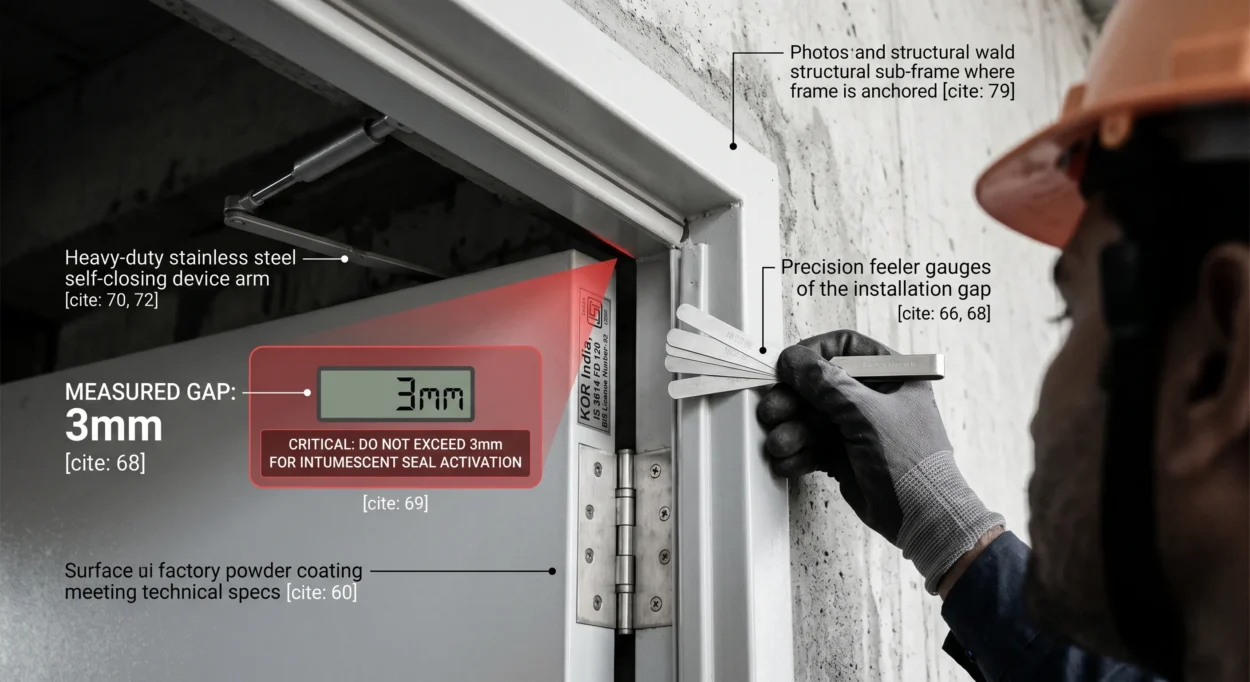
- Measure Critical Installation Gaps: Ensure the gap between the door leaf, the top header, and the side jamb frames does not exceed 3mm. This specific 3mm gap profile is essential to let the door close correctly while allowing intumescent seals to fill the void during a fire.
- Confirm Self-Closing Functionality: Open the door to its maximum angle and let it go. The door closer must smoothly pull the door leaf until it latches completely, overcoming air pressure differentials.
- Inspect Fire-Rated Hardware Fitment: Ensure panic bars, mortise locks, and lever handles are securely anchored with fire-rated steel fasteners. Non-rated screws will strip or sheer off under thermodynamic warp.
Bulleted Checklist for Maintenance Protocols
To comply with local regulations and secure long-term life safety, implement an annual maintenance plan (AMC) including these checks:
- Inspect intumescent strip seals for mechanical wear, peeling, or paint overruns.
- Check that panic hardware operates smoothly with less than 65 Newtons of physical push force.
- Verify the structural integrity of the leaf surface, ensuring no deep corrosion spots have compromised the 1.2mm GI sheet steel skin.
- Audit the structural frame anchors to confirm they remain solidly embedded in the brickwork or concrete drywall structural sub-frame.
Why KOR India is the Trusted Choice for Steel Fire Doors
Manufacturing Excellence and Joint Venture Engineering
KORINDIA Precision Private Limited represents a strategic industrial collaboration between Hallim Precision Co. Limited (South Korea)—bringing global technical manufacturing experience since 1983—and Hasa Engineering. This joint venture provides advanced passive fire technology tailored specifically for Indian building conditions.
Localized Infrastructure Supporting Major Hubs
Operating out of an automated, precision manufacturing facility at D-10/3, Site-5, Kasna Industrial Area, UPSIDC, Greater Noida, Uttar Pradesh, KOR India manufactures high-volume structural runs for major infrastructure projects across the country. This centralized operation optimizes logistical supply routes, allowing prompt delivery of certified assemblies to sites throughout Delhi NCR, Mumbai, and Bangalore.
From custom vision panel fire doors for corporate offices to robust industrial fire doors engineered for heavy-duty manufacturing environments, KOR India provides end-to-end solutions spanning professional site audits, customized engineering design, professional installation, and ongoing maintenance support.
Frequently Asked Questions (FAQ)
The total investment for a BIS-certified fire door varies based on size, custom hardware requirements (like panic bars and external trim), and specific fire durations (FD 60 vs FD 120). While base commercial steel doors cost less initially, choosing certified structural assets from leading fire door manufacturers guarantees compliance and long-term durability, minimizing total lifetime ownership costs. For custom site requirements, contact KOR India’s engineering team for an exact project estimate.
Hospitals and healthcare facilities require distinct fire resistance periods depending on where they are placed inside the building layout. Standard patient room entries and administrative zones typically utilize 60-minute fire safety doors. However, critical high-risk areas—including oxygen storage vaults, ICU wards, electrical sub-stations, and primary emergency stairwells—require 120-minute steel fire doors to maximize evacuation times for non-ambulatory patients.
Under NBC 2016, factories and industrial warehouses must design escape paths based on calculated occupancy loads and safe travel distances. Exit access doors must open outward in the direction of travel, remain unlatched from the inside during working hours, and incorporate fire-rated panic hardware. Additionally, these egress passages must be isolated from manufacturing areas using certified industrial fire doors to block toxic smoke entry.
KOR India is an industry-leading provider of high-performance fire doors, operating an automated manufacturing plant in the Kasna Industrial Area of Greater Noida. Backed by decades of international engineering experience, the company serves as a comprehensive partner for commercial, industrial, and infrastructure developments throughout northern India.