Choosing between steel fire doors and wooden fire doors isn’t just a design decision – it’s a life-safety one. Get the fire door core material wrong for a stairwell or a boardroom, and you’re either compromising escape routes or wrecking the aesthetic your client paid for.
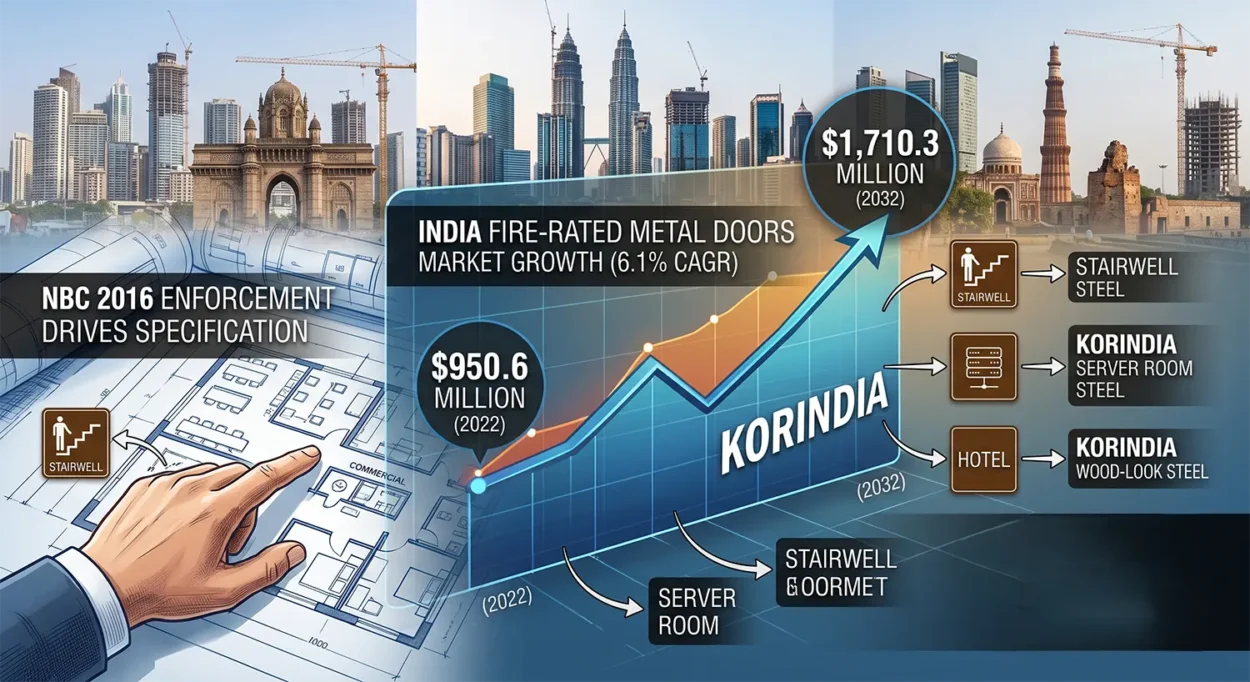
India’s fire-rated metal doors segment alone was valued at $950.6 million in 2022 and is projected to touch $1,710.3 million by 2032, growing at a 6.1% CAGR (Allied Market Research, 2023). That growth is being driven by one uncomfortable fact: most Indian project teams still specify fire doors by price, not by application. This guide fixes that.
The short answer: steel fire doors are the safer default above a 90-minute rating and in high-traffic industrial zones, while wooden fire doors remain the better call for hotel lobbies, boardrooms, and premium residences up to FD60. The rest of this guide breaks down why – and what to look for from steel fire doors suppliers in India before you lock a schedule.
Key Takeaways
- Steel fire doors typically hold FD90–FD120 ratings and dominate industrial, stairwell, and server room specs; wooden fire doors cap out around FD120 too, but usually at a lower price-to-rating ratio (IS 3614:2021).
- India’s fire door market is expected to grow past $1.7 billion by 2032 as NBC 2016 enforcement tightens (Allied Market Research, 2023).
- Steel wins on durability and fire resistance; wood wins on warmth and hospitality-grade aesthetics – but only up to a point.
- KORINDIA closes the aesthetics gap on steel with high-grade laminate, veneer-look, and powder-coat finishes, so you don’t have to trade safety for design.
Every fire door quoted must be a certified doorset – leaf, frame, seals, and hardware tested together per IS 3614 Part 2.
What Actually Separates a Steel Fire Door From a Wooden One?
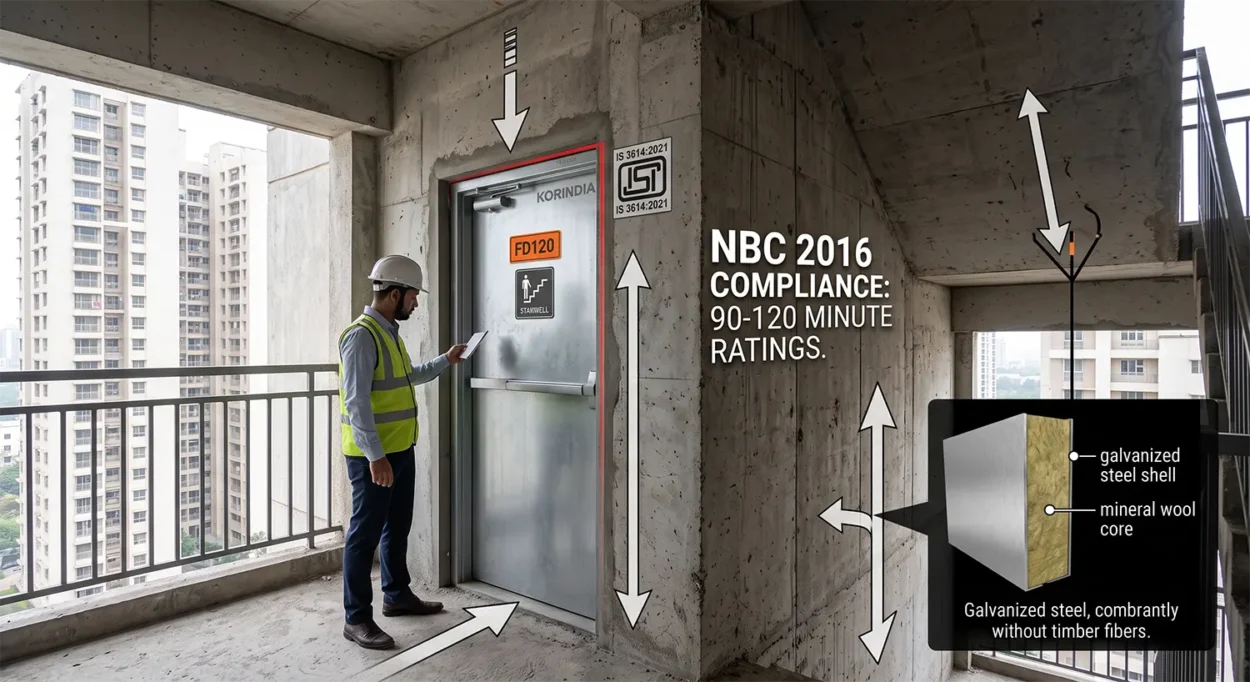
Fire doors are one of the most basic pieces of passive fire protection built into any Indian commercial building – and the core material, not the paint job, is what determines how one actually performs. Steel fire doors use a galvanized steel shell filled with a resin-bonded mineral wool or rockwool core, tested under IS 3614 Part 2 and BS 476 Part 22. Wooden fire doors use a solid or engineered timber leaf, often with a gypsum, vermiculite, or mineral-core infill sandwiched between veneer faces.
Both can be certified, and both show up in Indian project specs constantly. But the underlying fire door core material changes everything downstream – how long the door resists flame, how it ages on-site, and how it looks in a lobby versus a plant room.
As per IS 3614:2021, the minimum steel sheet thickness for frames and shutters is 1.2 mm (18 gauge) for a 150 mm frame depth, and the infill must be resin-bonded mineral or rock wool. That single spec line is why steel dominates high-hazard zones: the standard was effectively written around it.
If you’re a contractor comparing quotes right now, the fastest way to separate serious steel fire doors suppliers in India from box-shifters is one question: can they hand you the CBRI or ILAC-MRA-accredited NABL test certificate for the exact assembly they’re quoting, not a similar one?
Fire Resistance Duration: Who Actually Buys You More Time?
On paper, both materials can hit the same numbers. Under IS 3614:2021 and NBC 2016, fire doors in India are commonly rated at 30, 60, 90, or 120 minutes, verified through testing at labs such as CBRI Roorkee (KOR India, 2026). In practice, steel assemblies dominate the 90- and 120-minute segment because the metal shell holds the mineral wool core rigid at extreme furnace temperatures far longer than timber fibers do.
Wooden fire doors are genuinely capable at FD30 and FD60 when built with resin-bonded cores – and manufacturers like Packsound now push wooden doorsets up to 120-minute (also called a 2-hour fire rated door) ratings under BS 476 Part 22 and IS 3614 Part 2. But go higher, and cost and construction complexity climb fast: 120-minute wooden fire doorsets in India typically run ₹30,000–₹70,000 per set, against a much lower entry point for standard 60-minute steel assemblies (Ecotone Buyer Guide, 2026).
Under NBC 2016, buildings above 45 metres generally need 90- or 120-minute ratings at stairwell enclosures, and horizontal exits through fire-resistant walls require a 120-minute rated door under Part 4 of the National Building Code. That’s the exact threshold where steel fire doors suppliers in India get the call – timber can technically comply, but the assembly gets heavier, thicker, and pricier to hit the same number.
Verdict: For anything above FD60 in a high-hazard or high-rise stairwell, steel is the more forgiving, more field-proven choice.
Durability: Long-Term Wear in Real Buildings
Fire resistance is a lab test. Durability is what happens after five years of trolleys, forklifts, humidity, and slamming.
Steel fire doors shrug off impact, moisture, and pest damage in a way timber structurally cannot. That’s why fire steel doors held the largest revenue share by material in India’s fireproof door market in 2022 – steel’s durability and minimal maintenance profile made it the default for industrial and commercial specs (Verified Market Research, 2023). In a factory or a loading bay, a wooden door swells, warps, or gets forklift-scarred within a couple of monsoon seasons; a properly coated steel door doesn’t.
Wooden fire doors, by contrast, are more sensitive to moisture cycling, and their intumescent seals need more careful maintenance – India’s fire safety guidance recommends replacing intumescent strips every 3 years or immediately after damage to preserve smoke-sealing performance. Get lax about that in a hotel corridor, and the door’s rating quietly degrades even though it still looks fine.
A properly manufactured, installed, and maintained fire rated doorset has a service life of 20 to 30 years or more, but that lifespan depends entirely on the ongoing integrity of the assembly – not just the leaf (Packsound Buyer Guide, 2026). Steel holds that integrity with far less intervention.Verdict: Steel wins decisively for high-traffic, high-humidity, or industrial-duty applications. Wood needs a real maintenance plan to get anywhere close.
Aesthetics: Where Wood Traditionally Wins – and Where Steel Is Catching Up
This is the metric interior designers actually lose sleep over. Nobody wants a boardroom or a hotel lobby to look like a stairwell.
Timber has always owned the premium look – natural grain, warm tones, and the ability to match bespoke joinery. That’s a big reason India remains unusual globally: while most fire door markets prioritize steel, fire-resistant timber doors dominate a large share of Indian demand specifically because of cultural preference and cost-effectiveness in residential and hospitality settings (Bonafide Research, 2024).
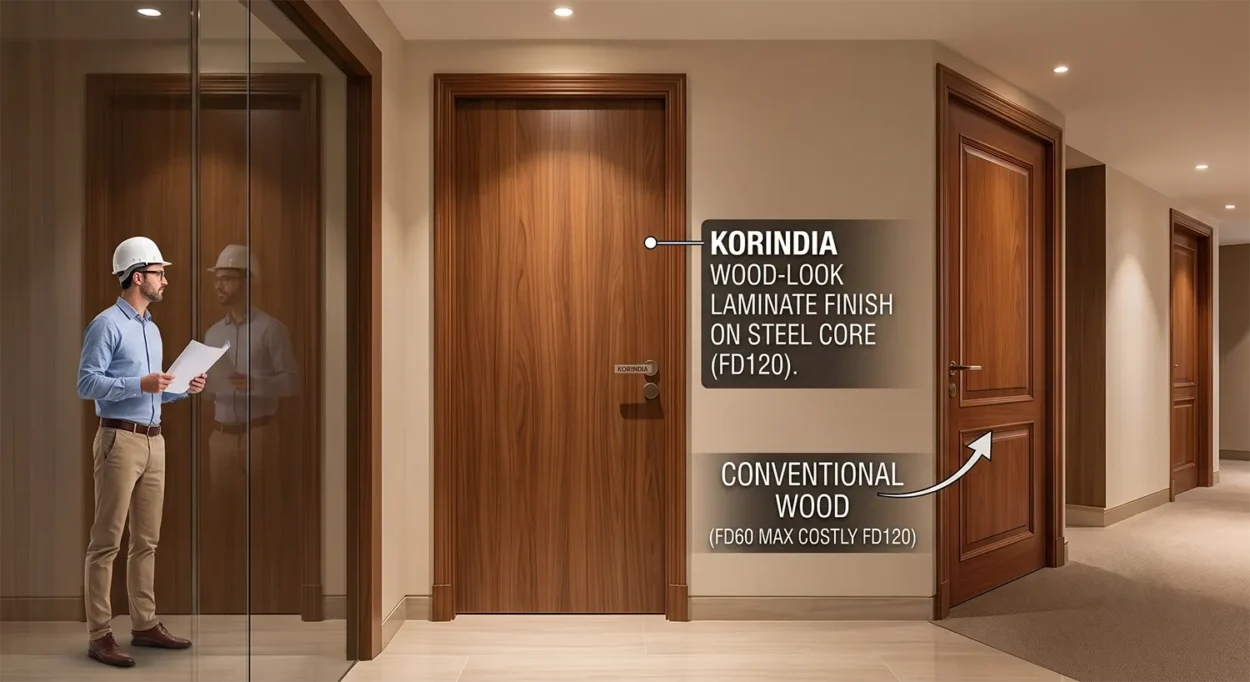
But “steel looks industrial” is quickly becoming an outdated assumption. Modern finishing technology – laminates, veneer-wrap finishes, and premium powder-coat palettes – can now visually replicate timber, matte metal, or even stone-textured surfaces on a steel core. That’s precisely the gap KORINDIA is built to close: our steel fire doors ship with high-grade finishing options – from veneer-look laminates to designer powder-coats – specifically so architects don’t have to downgrade a heavy-duty metal door to get a boardroom-appropriate finish.Verdict: Wood still edges ahead in pure warmth for legacy hospitality interiors, but with the right supplier, steel no longer forces a design compromise.
Cost: What You’re Actually Paying For
Sticker price tells you almost nothing on its own – rating, finish, and hardware move the number far more than material does.
Standard 60-minute wooden fire doorsets in India, painted or laminate finish, typically run ₹15,000–₹35,000 including frame and rated hardware, while 120-minute wooden doorsets climb to ₹30,000–₹70,000 (Ecotone Buyer Guide, 2026). Entry-level 60-minute fire-rated doors of any material commonly start around ₹9,000, though that figure moves fast once you add certified hardware, glazing, or acoustic performance (JC Fire Door, 2025). Treat any fire rated doors price list you’re handed as a starting point, not a quote – rating, finish, and hardware move the final number more than the base material does.
Steel doors often start with a higher base cost per leaf, but the total cost of ownership tells a different story once you factor in wood’s shorter maintenance cycle, seal replacement, and moisture-related repairs over a 20–30 year service life. For a factory, server room, or stairwell running three shifts a day, steel’s lower lifecycle cost usually overtakes wood’s lower entry price within a few years.Verdict: Wood can be cheaper upfront at lower ratings; steel is usually cheaper over the building’s lifetime in high-duty zones.
Steel vs. Wooden Fire Doors: Quick Comparison
| Metric | Steel Fire Doors | Wooden Fire Doors |
| Fire resistance duration | Commonly FD60–FD120; dominant above FD90 | FD30–FD60 standard; FD120 possible but costlier |
| Durability | High impact, moisture, pest resistance; low maintenance | Moisture-sensitive; needs regular seal upkeep |
| Aesthetics | Industrial by default; premium finishes now close the gap | Warm, natural, hospitality-grade by default |
| Cost | Higher upfront, lower 20–30 year lifecycle cost | Lower upfront at low ratings, pricier at FD120 |
Application Matching: Putting the Right Door in the Right Room
Here’s the part most specification sheets skip – the same building usually needs both materials, not one or the other.
Where wooden fire doors fit best:
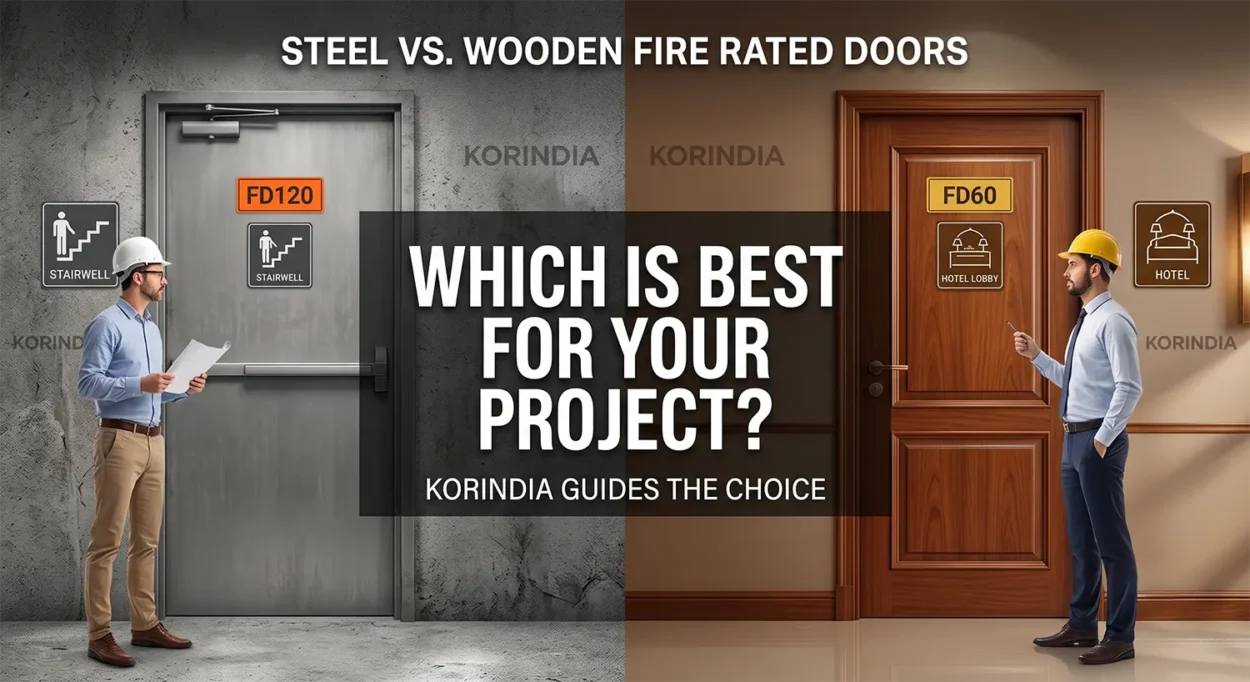
- Hotel lobbies and guest corridors, where FD30–FD60 timber doors preserve the interior design language
- Boardrooms and executive floors, where acoustic-rated wooden fire doors (some hitting STC 45 alongside their fire rating) double as sound insulation
- Premium residential towers and gated communities, where buyers expect joinery that matches the rest of the unit
Where steel fire doors fit best:
- Stairwell enclosures and lift lobbies above 15–45 metres, where NBC 2016 typically demands 60- to 120-minute ratings
- Factories, warehouses, and plant rooms, where impact resistance and low maintenance matter more than warmth
- Server rooms, electrical switch rooms, and data centre risers, where a 90-minute steel rating is the common specification (Ecotone Buyer Guide, 2026)
- Hospitals and healthcare corridors, where a steel door’s non-porous, low-maintenance surface supports infection-control protocols alongside the fire rating
- Airports, stadiums, and other high-footfall public buildings, where steel’s impact resistance holds up to FD90–FD120 performance across large door schedules
Rhetorical question worth asking before you finalize a schedule: does every door on this floor plan actually need the same rating and the same material? Almost never – and treating it that way is where budgets and design intent both get lost.
Why Architects and Contractors Specify KORINDIA
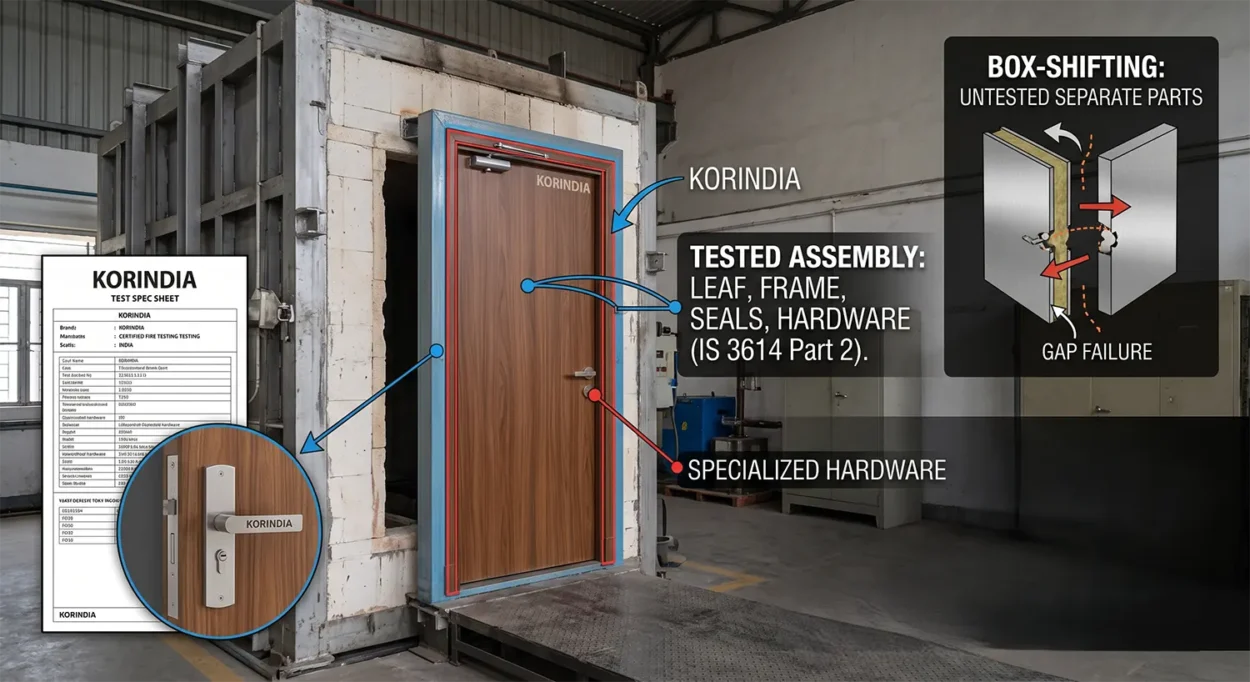
KORINDIA is an ISO 9001-certified fire rated doors manufacturer and supplier, with a manufacturing base in Greater Noida serving architects and fit-out contractors across Noida, Delhi NCR, and Uttar Pradesh, as well as project sites pan-India. As one of the established steel fire doors suppliers in India – and an industrial door manufacturer building for factories, server rooms, and mixed-use commercial towers – we manufacture IS 3614 and BS 476-tested steel fire doors and test every doorset, leaf, frame, seals, and hardware, as one certified assembly, not as separately sourced parts value-engineered together on-site.
What changes the conversation for interior designers specifically is finishing. KORINDIA offers high-grade finishing options – veneer-look laminates, matte and metallic powder-coats, and custom colour matching – that let heavy-duty metal doors sit comfortably in a client-facing lobby or boardroom corridor, not just a back-of-house stairwell. You get the FD90–FD120 performance industrial and high-rise projects require, without the door looking like it belongs in a plant room. For fit-out contractors managing multi-material schedules – wooden doors for guest floors, steel for risers and stairwells – KORINDIA also supports project-specific documentation: test certificates, shop drawings, and door schedules that make fire NOC approval faster, not slower, across hospitality, industrial, healthcare, and government project types.
Frequently Asked Questions
Not always – it depends on the application. Steel is the stronger choice above a 90-minute rating and in high-traffic industrial zones, while wooden fire doors remain fully compliant and often preferable for hotel and residential interiors up to FD60 (IS 3614:2021).
Under NBC 2016, commercial fire doors typically need a 60-minute rating for stairwells and corridors in mid-rise buildings, rising to 90 or 120 minutes for buildings above 45 metres or high-hazard industrial zones (National Building Code, 2016).
Yes, up to a point. Wooden fire doors with resin-bonded mineral cores can now reach 120-minute ratings under BS 476 Part 22 and IS 3614 Part 2, though the assembly typically costs more than an equivalent steel door at the same rating (Packsound Buyer Guide, 2026).
Certified steel fire doors use a galvanized steel shell – minimum 1.2 mm sheet thickness per IS 3614:2021 – filled with a resin-bonded mineral wool or rockwool core that holds its shape under sustained furnace-level heat.
Ask for the CBRI or ILAC-MRA-accredited NABL test certificate for the exact doorset being quoted, not a similar model. A reliable supplier tests leaf, frame, seals, and hardware together and provides shop drawings and maintenance documentation for fire NOC approval.
A fire rated door is a tested doorset – leaf, frame, seals, and hardware together – certified to resist fire and smoke for a set duration, typically 30 to 120 minutes under IS 3614. The fire door core material (steel with mineral wool, or timber with a resin-bonded infill) is what actually determines that duration, along with how the door ages and performs after years of real-world use.
Wooden fire doors still win the room where warmth and hospitality-grade finish matter most – lobbies, boardrooms, premium residences. Steel fire doors win everywhere durability, high fire ratings, and long-term maintenance-free performance matter most – stairwells, factories, server rooms. The mistake isn’t picking one material; it’s picking one material for the whole building.
KORINDIA supplies both categories to architects and fit-out contractors across India, backed by IS 3614 and BS 476 test certification and finishing options built specifically to make heavy-duty steel doors look like they belong in a client-facing space. Whether you need a steel fire doors supplier in India for a factory riser or a wood specialist for a hotel corridor, talk to KORINDIA’s technical team before you lock the BOQ.