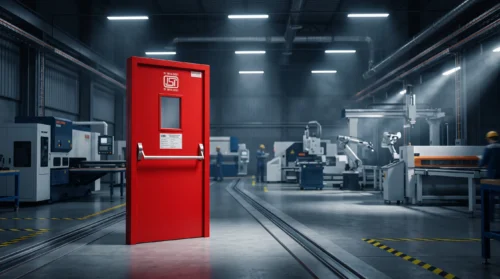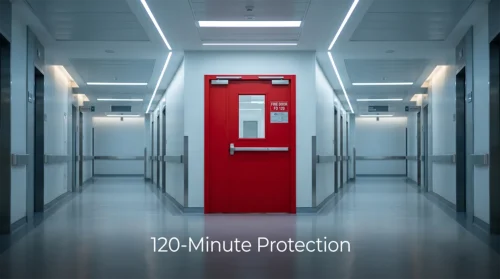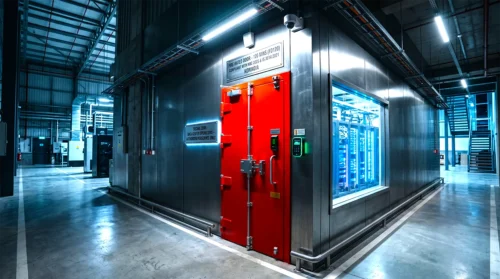
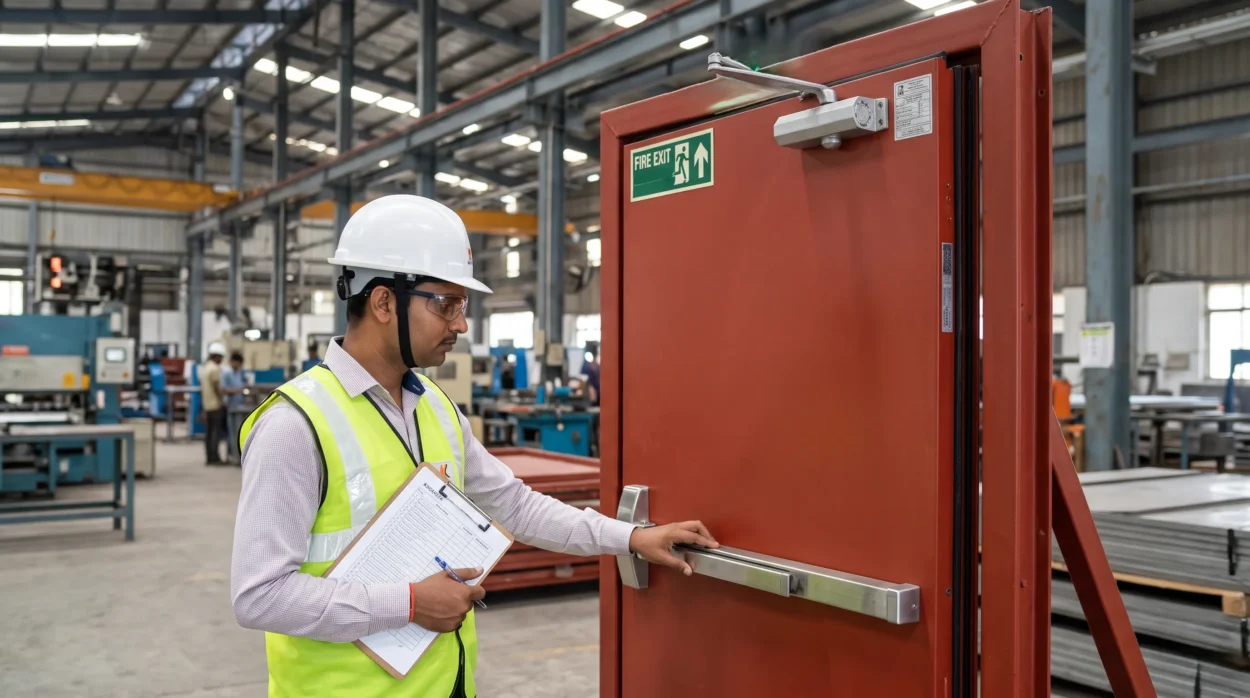
A fire door does not work because it has a strong leaf alone. It works because the leaf, frame, hinges, closer, latch, exit device and seals operate together as one tested assembly. In factories, warehouses and industrial plants, industrial fire door hardware is therefore not an accessory-it is a life-safety system.
Many projects focus on the fire rating of the door leaf but overlook the ironmongery. Yet a correctly rated leaf can fail in service if it is hung on unsuitable hinges, wedged open, fitted with a non-rated panic device, or unable to close and latch fully. This guide explains the hardware that matters most in industrial buildings and how to specify it correctly.
What Is Industrial Fire Door Hardware?
Industrial fire door hardware includes every operating component fitted to a fire-rated door assembly: hinges, closers, panic bars, locks, flush bolts, seals, coordinators and related fittings. Each item must suit the tested doorset, not merely look compatible with it.
Under IS 3614:2021, hardware used on fire doors must be fire-rated and certified, with limited exemptions for certain stainless-steel hinges and pull handles. Functional items such as locks, panic devices, lever handles and door closers must be type-tested and certified for use on fire doors at the specified rating. In simple terms: the certificate belongs to the complete doorset. A certified leaf fitted with uncertified or incompatible hardware is no longer a certified fire door assembly.
Why Hardware Defines Fire Door Performance
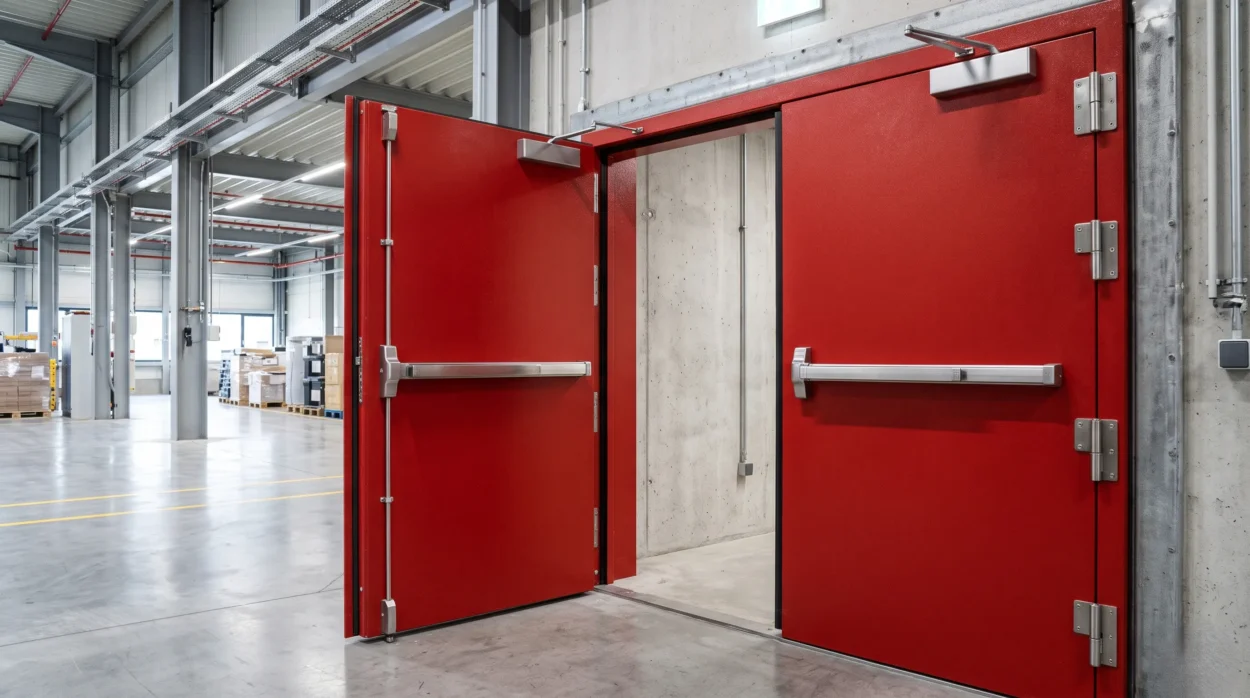
A fire door has three jobs during an emergency:
- Remain closed and positively latched.
- Restrict the passage of flames, hot gases and smoke.
- Allow people to escape quickly and safely.
Hardware enables all three. Hinges keep the leaf aligned; the closer returns it to the frame; the lock, latch or fire exit device secures it; and seals reduce smoke and heat movement. NFPA 80 similarly treats fire doors as operable assemblies that must open, close and latch correctly, and it prohibits wedging doors open. For factories, the stakes are higher because doors face forklift traffic, dust, moisture, frequent opening cycles and heavy usage. A hardware specification that works in an office corridor may not survive a loading bay or production floor.
Fire Rated Hinges: The Foundation of the Door
Hinges carry the entire weight of the leaf and control its alignment with the frame. If they sag, wear out or are fixed incorrectly, the door may bind, leave excessive gaps, or fail to latch.
Hinge type and number
There is no universal rule that says every industrial fire door needs three hinges. The correct number, size, material and fixing pattern should follow the tested design of the doorset. IS 3614:2021 does not prescribe a hinge count; instead, hinge count, position and fixing form part of the tested assembly evidence.
As a practical industrial guideline:
- Light to medium single-leaf doors commonly use three hinges.
- Tall, wide or heavy steel leaves may require additional hinges or heavy-duty hinges.
- Double-leaf doors need each leaf assessed separately.
High-traffic factory doors should use ball-bearing or heavy-duty hinges where the tested design permits.
What to check
Use hinges that match the door weight, width, frequency of use and tested hardware schedule. For Indian fire doors, IS 3614:2021 provides an exemption for hinges of minimum 100 mm x 75 mm x 3 mm in stainless steel grade SS 304 or above; smaller or lower-grade hinges require separate fire certification. Avoid substituting hinges based only on appearance. Two hinges may look alike but differ in bearing type, screw pattern, load capacity and certification scope.
Fire Door Closers: Sizing and Adjustment
A fire door closer is mandatory because a fire door must self-close after every use. IS 3614:2021 states that all installed fire doors shall be self-closing, and the closer must be type-tested and certified for the relevant rating.
How to size a fire door closer
Closer selection depends on more than door width. Consider:
- Leaf width and height
- Door weight
- Opening angle
- Wind, draught or air-pressure conditions
- Seal resistance
- Frequency of use
- Whether the door is internal or external
EN 1154 classifies controlled door-closing devices using power sizes generally from EN 1 to EN 7. Higher sizes provide greater closing force for wider and heavier doors; for example, EN 3 is typically associated with doors up to 950 mm wide and 60 kg, while EN 6 relates to doors up to 1,400 mm wide and 120 kg.
| Door condition | Closer selection approach |
| Light internal single leaf | Select the minimum tested power size that closes and latches reliably |
| Heavy industrial steel leaf | Size for actual door mass, width and seal resistance |
| External door exposed to wind | Choose a higher power size only if permitted by the tested assembly |
| Double-leaf exit door | Use coordinated closers and verify the closing sequence |
| Door that fails to latch | Correct alignment, hinges, seals or strike before increasing closer power |
Do not use a stronger closer to hide another problem. If a door will not close, first check hinge wear, frame alignment, floor contact, seal friction and latch alignment. Excessive closer force can make the door difficult to open, damage seals and accelerate hardware wear. KORINDIA manufactures fire door leaves with internal supporting plates at key hardware locations, including areas intended for door closer fitting. This factory-prepared reinforcement helps installers secure hardware correctly without unsupported site drilling.
Panic Bars and Fire Exit Door Hardware India
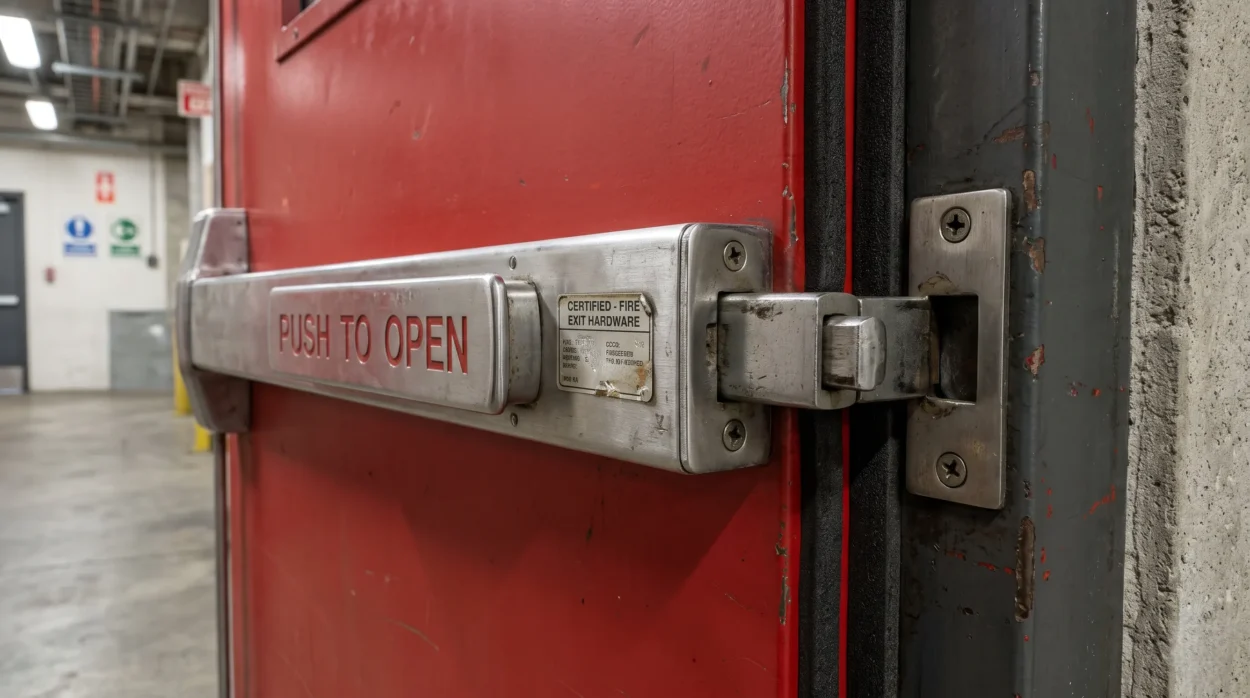
A fire door panic bar allows a person to release the door by applying pressure in the direction of escape. In Indian factories, panic hardware is especially important at fire exits, assembly areas, high-hazard zones and escape routes where occupants must leave without searching for a key or operating a lever.
Panic bar versus fire exit hardware
These terms are often used interchangeably, but they are not the same.
| Hardware type | Where it is used | Key requirement |
| Panic hardware | Non-fire-rated egress doors | Provides quick one-motion egress |
| Fire exit hardware | Fire-rated exit doors | Provides egress and is certified for the fire door assembly |
| Standard panic device on a fire door | Not acceptable | It may not maintain the required positive latching |
Fire exit hardware is panic hardware that is additionally tested and listed for use on fire door assemblies. It must allow easy egress while ensuring the door positively latches when closed.
Fire exit door hardware India: practical rules
For fire exit door hardware India projects, specify:
- Fire exit hardware certified for the door’s rating and tested configuration.
- A touchpad or crossbar that extends across at least half the leaf width where required by the applicable egress code.
- No mechanical dogging feature that keeps the latch retracted.
- No additional padlock, chain, hasp or auxiliary lock that prevents immediate escape.
- Compatible external trim, cylinder and access-control arrangement where security is needed.
IS 3614:2021 requires a visible certification label on panic devices and permits panic-device projection within the clear door width. It also requires concealed lever-action flush bolts at the top and bottom of the inactive leaf of double-leaf doors, except panic-device doors.
Locks, Latches and Flush Bolts
Closing and latching are different functions. A closer can shut the door, but only a suitable latch, lock or fire exit device can hold it positively closed.
Single-leaf industrial doors
For a single-leaf fire door, use a certified mortise lock, latch or fire exit device that matches the tested preparation. The latch must engage the strike fully without forcing, filing or modifying the frame on site. Deadbolts may be permitted only where the doorset has been tested for that condition. A deadbolt alone does not provide the same positive-latching performance as a spring latch unless the tested assembly specifically allows it.
Double-leaf fire doors
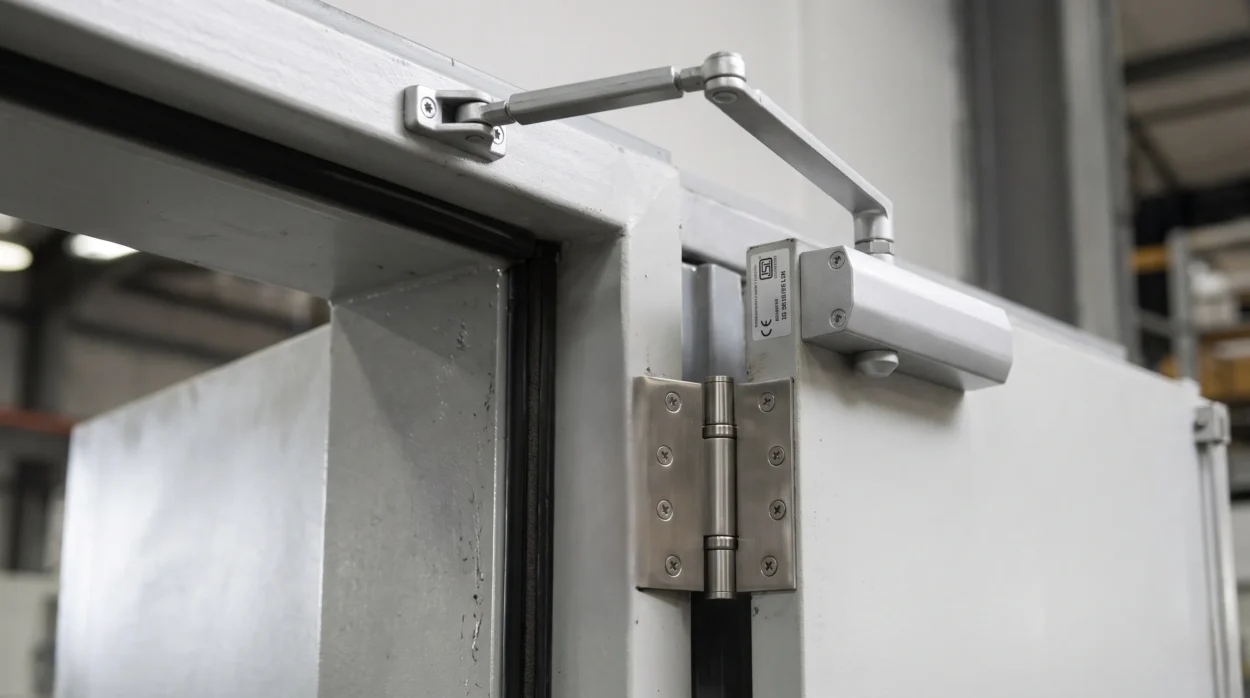
Double doors need greater coordination. The inactive leaf is normally secured with flush bolts at the top and bottom, while the active leaf carries the main lock, latch or panic device.
For pairs, also consider:
- Astragal or meeting-stile detail
- Door coordinator
- Closing sequence
- Active and inactive leaf identification
- Compatibility of both closers and latching devices
IS 3614:2021 requires double-leaf fire doors to have concealed lever-action flush bolts on the inactive leaf and to be tested with astragals.
Seals and Gaskets: Small Parts, Major Role
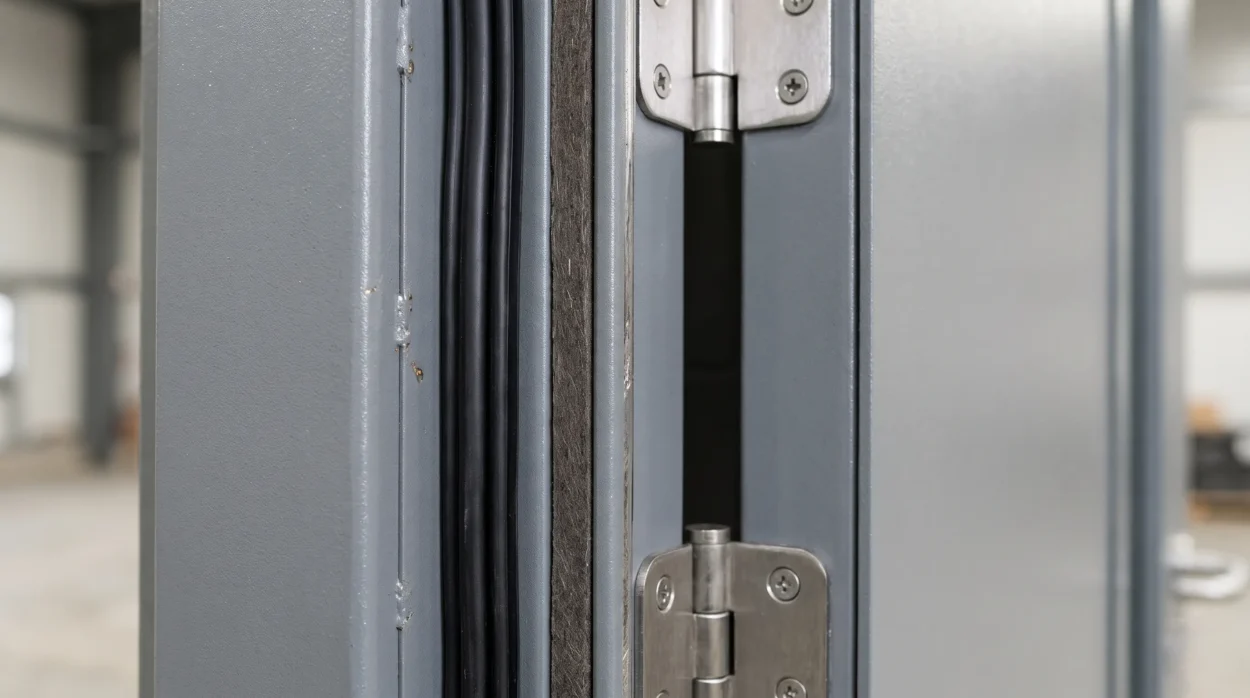
Seals are often treated as finishing items, but they are essential components of the fire door assembly.
Intumescent seals
Intumescent seals remain dormant at normal temperature. During a fire, they expand and help close the gap between the door leaf and frame, supporting integrity and insulation performance.
Smoke seals
Smoke seals, commonly made from suitable fire-rated EPDM or equivalent gasket material, restrict cold smoke before temperatures rise. They protect escape routes even in the early stage of a fire.
IS 3614:2021 requires both smoke seals and intumescent seals as standard components of fire door assemblies. Intumescent seals are required on the relevant edges of the leaf and meeting stile of double-leaf doors, or as per test evidence. Do not use a seal to compensate for an oversized gap, damaged frame or poorly aligned leaf. Correct the doorset first; then install the specified seal exactly as tested.
Hardware Must Match the Tested Assembly
The most important rule in fire door specification is compatibility. Hardware must match the tested assembly in model, size, function, fixing method and certification scope.
Before approving any hardware set, obtain:
- Door leaf and frame manufacturer details
- Fire rating and test report reference
- Exact hardware model numbers
- Hinge size, grade, quantity and fixing pattern
- Closer model, power size and mounting detail
- Panic device or fire exit hardware certification
- Lock or latch type and strike detail
- Flush bolt and coordinator details for pairs
- Seal type, position and certification evidence
A generic phrase such as “fire-rated hardware” is not enough. The exact product must be suitable for the specific rated opening.
Industrial Fire Door Hardware Checklist
Use this checklist during procurement, installation and periodic inspection.
| Hardware item | What to check | Common mistake |
| Hinges | Correct type, quantity, size, grade, fixings and alignment as per tested design | Replacing a certified hinge with a visually similar non-rated hinge |
| Door closer | Certified for fire door use; correct power size; door closes and latches fully | Increasing spring power to hide a misaligned door |
| Panic bar / fire exit device | Certified fire exit hardware; free egress; latch projects when closed | Installing standard panic hardware on a fire-rated exit door |
| Lock or latch | Correct model, function, backset, strike and positive latching | Filing the strike or altering the frame on site |
| Flush bolts | Present on inactive leaf where required; engage top and bottom correctly | Using a surface-mounted barrel bolt instead of a tested flush bolt |
| Seals | Correct intumescent and smoke seals; correct position; no damage | Removing a seal because it creates friction |
| Double-door coordinator | Ensures inactive leaf closes before active leaf | Ignoring the closing sequence during commissioning |
| Hold-open device | Electrified, detector-actuated and suitable for the location | Wedging the door open with a brick, stool or doorstop |
| Fasteners | Correct type, length and quantity; no unsupported site cutting | Drilling new holes in the leaf or frame without approval |
| Labels | Visible, legible and matching the certified assembly | Painting over or removing certification labels |
Common Hardware Mistakes in Factories
Industrial sites often compromise fire door performance through small operational habits. These are the most frequent mistakes:
- Wedging a fire door open. A wedge prevents self-closing and defeats the purpose of the assembly. NFPA 80 explicitly prohibits blocking or wedging fire doors open.
- Fitting non-rated hardware. A standard panic bar, ordinary lock or cheap hinge may not be certified for the tested fire door assembly.
- Using chains and padlocks on exits. IS 3614:2021 specifically disallows chains with padlocks, tower bolts, aldrops and slide bolts on fire doors.
- Ignoring door alignment. A sagging leaf changes clearances and prevents reliable latching.
- Oversizing the closer. A powerful closer may shut the door, but it can also create excessive opening force and damage seals.
- Cutting hardware pockets on site. Site fabrication can take the doorset outside its tested configuration. IS 3614:2021 expects factory preparation for hardware.
- Treating inspection as a label check. A fire door must be functionally tested: it should open freely, close fully and latch without assistance.
Maintenance and Inspection
Fire door hardware should be inspected after installation and then at regular intervals. NFPA 80 requires inspection and testing immediately after installation and at least annually thereafter, carried out by a qualified person.
A practical factory maintenance routine should include:
- Check hinges for looseness, wear, sag and missing screws.
- Open the door fully and allow the closer to close it without assistance.
- Confirm the latch engages positively every time.
- Test panic bars from the egress side.
- Inspect seals for damage, compression set or missing sections.
- Verify that no wedge, chain, bolt or improvised stop is present.
- Record findings, corrective actions and replacement hardware details.
If replacement is necessary, do not assume “like-for-like” based on appearance. Match the exact model, certification scope, function and installation requirements of the original tested assembly.
Choosing KORINDIA for Industrial Fire Doors
KORINDIA manufactures fire-rated steel doors designed for industrial and commercial applications where reliability, compliance and durability matter. Every KORINDIA doorset should be specified with hardware that matches its tested configuration, including certified closers, fire exit hardware, hinges, locks, seals and flush bolts.
KORINDIA leaves include supporting plates inside for fitting items such as door closers, helping ensure strong, factory-prepared fixing points for critical hardware. For project-specific guidance, explore KORINDIA’s fire rated doors and review the fire door ratings guide for IS 3614 and NBC requirements.
If you are planning fire exits, staircase enclosures, electrical rooms, warehouse compartments or factory escape routes, consult KORINDIA before finalising the hardware schedule. The right industrial fire door hardware protects people, preserves compartmentation and keeps your doorset compliant throughout its service life.
Frequently Asked Questions
No. A normal panic bar is intended for non-rated egress doors. A fire-rated exit door requires certified fire exit hardware that provides both emergency egress and compatibility with the tested fire door assembly.
There is no fixed number for every door. The hinge quantity, type, size and fixing arrangement must follow the tested doorset design. Heavy or tall industrial leaves may require more than the standard three hinges, but only as supported by the test evidence.
Select the closer based on door width, weight, opening angle, seals, wind exposure and usage. EN power sizes generally range from EN 1 to EN 7, with higher numbers suited to wider and heavier doors. Always confirm the exact closer model against the tested fire door assembly.
Only where permitted and only with an electrified hold-open device actuated by a fire or smoke detector. Mechanical wedges, doorstops and improvised hold-open arrangements are not compliant.
Common causes include hinge wear, door sag, frame distortion, incorrect strike alignment, excessive seal friction or an incorrectly adjusted closer. Correct the underlying issue first; do not simply increase closer force.