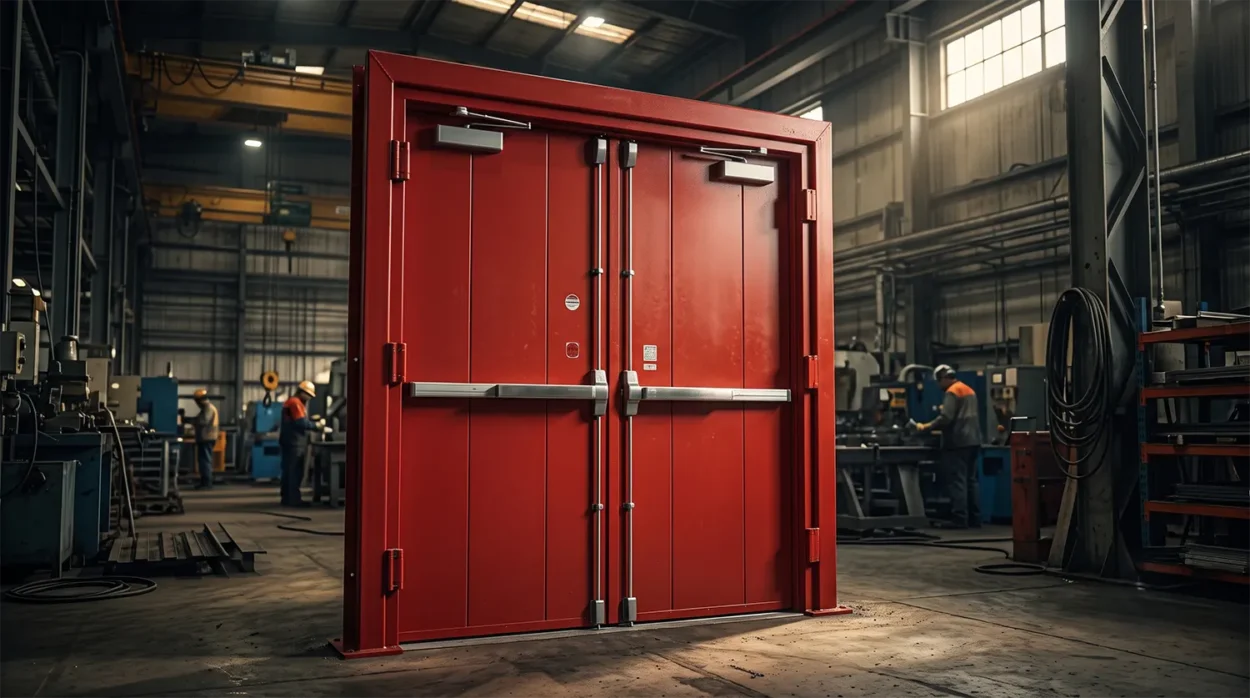
Steel fire rated doors are passive fire protection assemblies engineered from galvanized iron (GI) steel and thermal infill to compartmentalize fire, smoke, and radiant heat. Built to comply with IS 3614 and NBC 2016 standards, they offer fire resistance ratings of FD 60, FD 90, and FD 120 minutes. In India, prices typically range from ₹4,500 to ₹12,000 per square meter depending on integrity, insulation ratings, and hardware.
In high-density industrial and commercial developments, passive fire containment systems form the primary structural defense against catastrophic thermal runaway. Steel fire doors act as dynamic structural barriers, engineered to compartmentalize thermal energy, halt toxic gas migration, and preserve evacuation corridors during a structural blaze.
For structural engineers, MEP consultants, architects, and facility managers, procuring compliant fire rated doors is a critical life-safety requirement and a statutory mandate under the National Building Code (NBC 2016). As premier fire door manufacturers, KOR India engineers industrial-grade fire safety doors backed by four decades of South Korean precision engineering, designed to withstand rigorous hydrostatic and thermodynamic fire-curve testing.
What Are Steel Fire Rated Doors? Engineering & Core Mechanics
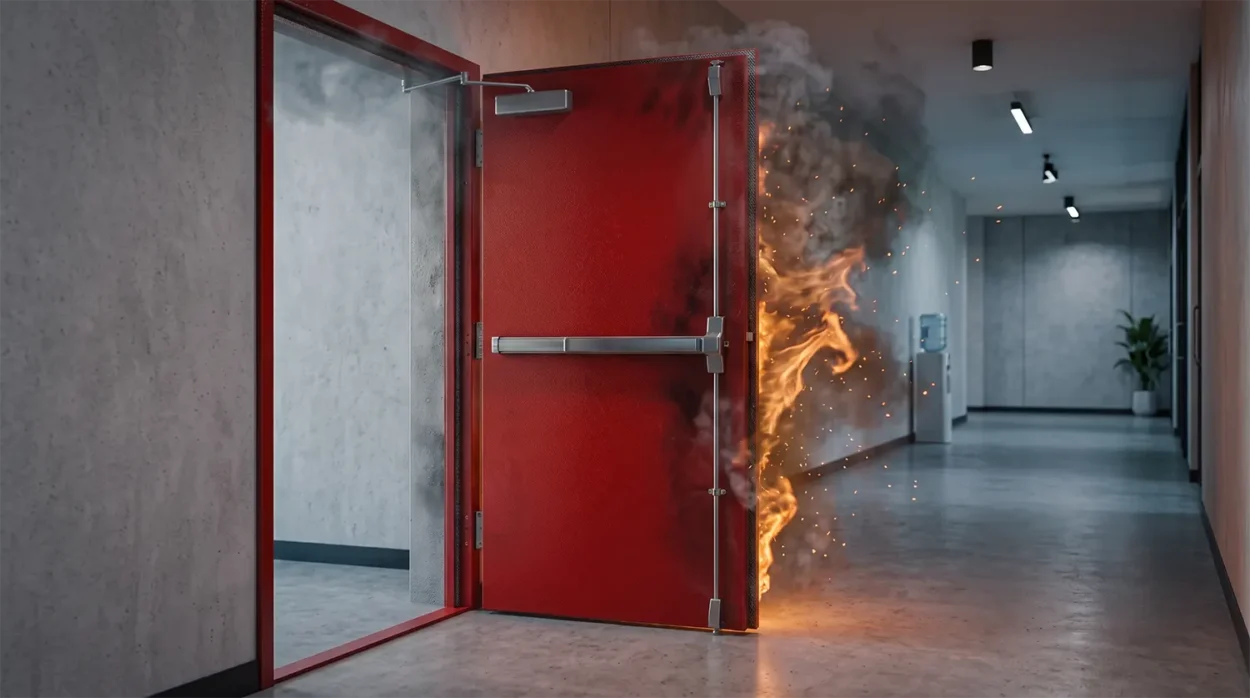
Technical Definition: A steel fire door is a calibrated life-safety assembly comprising a heavy-gauge steel door leaf, a reinforced structural frame, high-density insulating infill, intumescent perimeter seals, and tested fire-rated hardware designed to maintain compartmentation under standardized thermal stress.
Standard architectural doors buckle and conduct lethal heat within minutes of flashover. In contrast, steel fire doors are precision-engineered to maintain three core criteria during a blaze:
- Integrity (E): The mechanical ability to prevent the passage of flames and hot gases to the unexposed face.
- Insulation (I): The thermodynamic capacity to limit heat transfer, ensuring the cold face does not exceed an average rise of 140°C above ambient temperature.
- Radiation Reduction (W): Suppressing radiant heat flux to keep escape routes tenable.
When temperatures exceed 150°C, the intumescent seals expand up to 25 times their initial volume. This dynamic expansion fills the perimeter gap between the leaf and frame, preventing toxic smoke and carbon monoxide from leaking into pressurized escape stairs.
Technical Specifications of KOR India Steel Fire Doors
Manufactured at our automated facility in Greater Noida, KOR India’s industrial fire doors integrate high-yield galvanized steel sheets with high-density mineral wool cores, delivering structural stability and corrosion resistance across demanding operating environments.
Standard Engineering Data Sheet
| Specification Parameter | Technical Standard / Dimension | Compliance Reference |
| Leaf Sheet Metal | 1.2 mm (18 Gauge) Galvanized Iron (GI) | IS 277 / ASTM A653 |
| Frame Sheet Metal | 1.6 mm (16 Gauge) Folded GI Profile | IS 277 / IS 3614 |
| Core Infill Material | Resin-bonded Rockwool (96–144 kg/m³) or Honeycomb | IS 8183 / Non-combustible |
| Finish | Epoxy-polyester Powder Coating (60–80 microns) | Salt spray tested > 500 hrs |
| Vision Panel Glass | Clear Fire-Rated Glazing (up to 120 mins) | IS 16945 / BS 476 Part 22 |
| Smoke & Draft Seals | Self-adhesive Intumescent (10 mm x 4 mm minimum) | IS 3614 Part 2 |
| Tested Hardware | Heavy-duty ball-bearing hinges, panic exit device, door closer | EN 1935 / EN 1154 / EN 1125 |
All door assemblies are fabricated within 3 mm operational fitment tolerances to ensure immediate smoke containment upon latching.
Understanding Fire Door Ratings: FD 60, FD 90, and FD 120
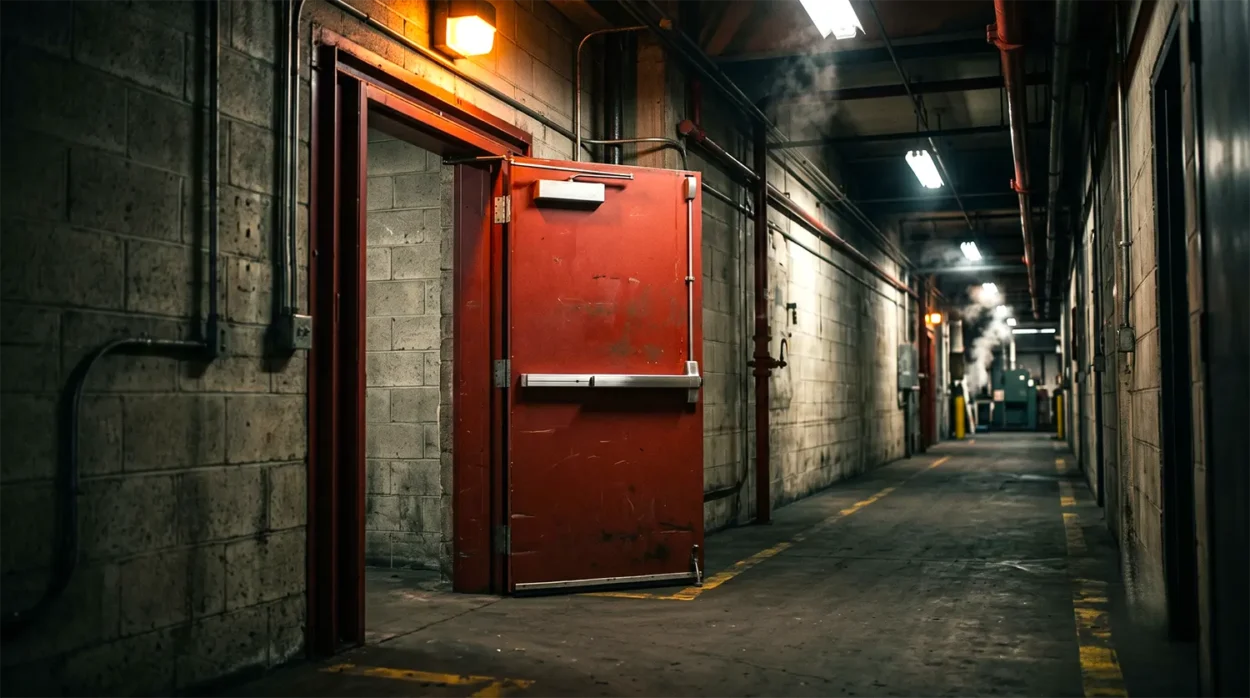
Fire ratings designate the precise duration—in minutes—that a fully assembled fire door withstands a continuous, standard ISO 834 fire curve without structural collapse or flame breakthrough. The primary commercial ratings in India are FD 60 (60 minutes), FD 90 (90 minutes), and FD 120 (120 minutes).
Selecting the appropriate fire rating requires aligning the project specification with the fire-load calculation of the occupancy class under the National Building Code (NBC 2016):
1. FD 60 (60-Minute Fire Resistance)
Designed primarily for secondary escape pathways, residential high-rises, corridor separations, and hospitality partition doors. The assembly limits flame breakthrough for an hour, allowing building occupants sufficient evacuation time during small-to-medium emergency events.
2. FD 90 (90-Minute Fire Resistance)
Specified in service shafts, electrical sub-stations, logistics staging hubs, and basement floor plans. An FD 90 rating provides a 1.5-hour thermal buffer, isolating mechanical service areas from occupied spaces.
3. FD 120 (120-Minute Fire Resistance)
Mandatory for life-safety fire exit staircases, high-voltage transformer rooms, clean rooms, data centers, and hospital ICU corridors. Tested at temperatures exceeding 1050°C, these assemblies maintain compartmentation and structural stability under extreme thermal conditions. Every KOR India rating variant undergoes full-scale testing at CBRI Roorkee and independent NABL-accredited fire laboratories to verify that leaf deflection, unexposed surface heat, and latch integrity comply with IS 3614:2021.
Industrial and Commercial Applications across Indian Infrastructure
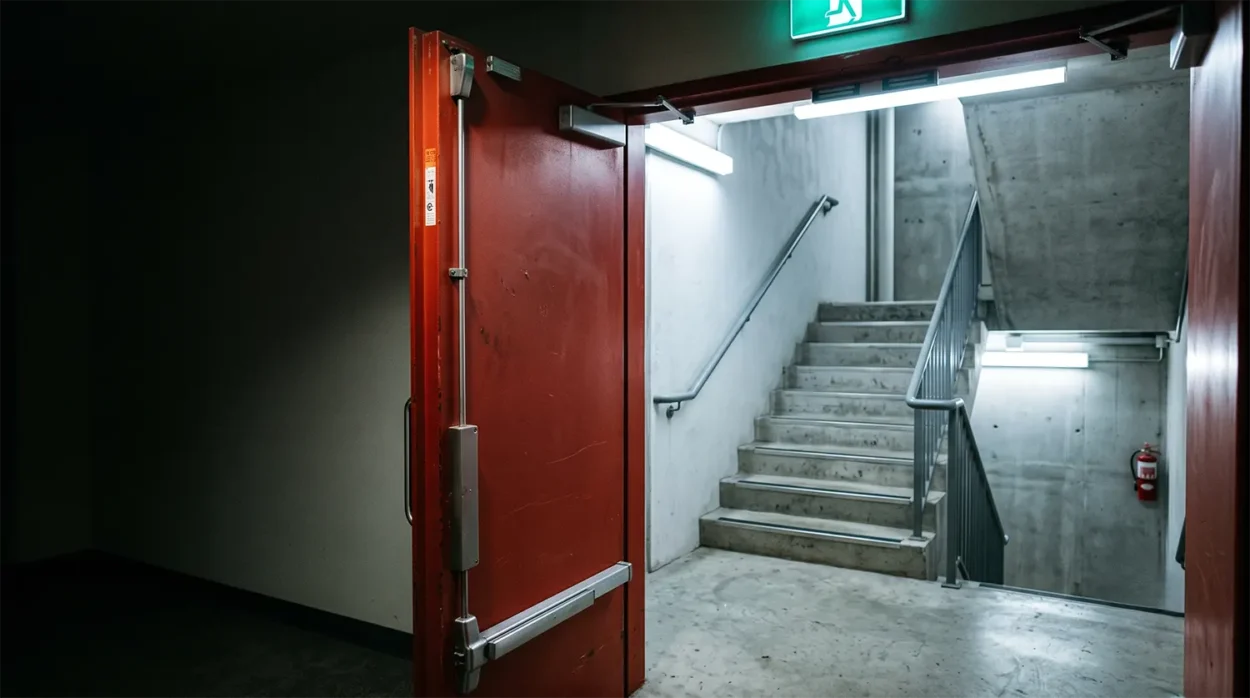
Selecting high-performance fire resistant doors depends on building occupancy profiles, expected occupant densities, and specialized architectural layouts:
1. Healthcare Facilities and Hospitals
Bedridden patients cannot evacuate quickly during emergencies, requiring a “defend-in-place” fire protection strategy. KOR India supplies hospitals—including large multi-specialty installations across Gurgaon and Delhi NCR—with vision panel fire doors. These doors feature fire-rated ceramic glass that provides visibility into corridors without breaking the fire barrier.
2. Industrial Plants, Manufacturing, and Warehouses
Manufacturing facilities house flammable hydrocarbons, combustible dust, and high electrical loads. Here, heavy-duty industrial fire doors prevent localized equipment fires from spreading across factory floors or storage bays.
3. High-Rise Commercial Complexes & Data Centers
Modern commercial buildings require fire-rated emergency exit staircases fitted with UL-listed or EN-standard panic exit hardware. This hardware allows hands-free, single-motion egress for safe evacuation, even in low-visibility or smoke-filled corridors.
4. Cleanrooms and Pharmaceutical Environments
In pharmaceutical laboratories, fire protection must coexist with cleanroom pressure differentials. KOR India’s specialized flush fire doors integrate non-shedding infill and continuous perimeter silicone seals, maintaining cleanroom certifications alongside fire integrity.
Steel Fire Rated Door Price Breakdown in India
The price of commercial-grade steel fire rated doors in India ranges from ₹4,500 to ₹12,000 per square meter (or roughly ₹18,000 to ₹45,000 per standard single-leaf unit). Final costs depend on the required fire rating (FD 60 vs FD 120), steel sheet gauge, glazed vision panel dimensions, and panic hardware integration.
Commercial Pricing Matrix (Indicative Budgetary Rates)
| Fire Rating | Standard Size (W x H mm) | Leaf / Frame Core Build | Approx. Price Range (INR / Unit) |
| FD 60 Single Leaf | 1000 x 2100 mm | 1.2mm / 1.6mm GI + Rockwool Infill | ₹18,500 – ₹24,000 |
| FD 60 Double Leaf | 2000 x 2100 mm | 1.2mm / 1.6mm GI + Rockwool Infill | ₹34,000 – ₹42,000 |
| FD 120 Single Leaf | 1000 x 2100 mm | 1.2mm / 1.6mm GI + High-Density Rockwool | ₹22,000 – ₹29,500 |
| FD 120 Double Leaf | 2000 x 2100 mm | 1.2mm / 1.6mm GI + High-Density Rockwool | ₹42,000 – ₹54,000 |
| FD 120 with Vision Panel | 1000 x 2100 mm | Clear fire-rated glass (200x300mm) + GI | ₹28,000 – ₹38,000 |
Key Cost Determinants
- Hardware Configurations: Basic lever handles are more economical, while certified panic exit crash bars, external trim, and concealed door closers (from hardware partners like Dorset, Geze, or Allegion) adjust the assembly cost.
- Vision Panels: Integrating clear fire-rated ceramic glass increases fabrication cost due to specialized framing and glazing beads.
- Custom Sizing vs Standard Modules: Custom rough openings require dedicated CAD reconfiguration and tooling, compared to cost-effective modular production runs.
- Surface Finishes: Factory powder coating in standard RAL shades remains cost-effective, while custom metallic or anti-microbial coatings adjust final quotes.
Regulatory Compliance: IS 3614:2021 and NBC 2016 Mandates
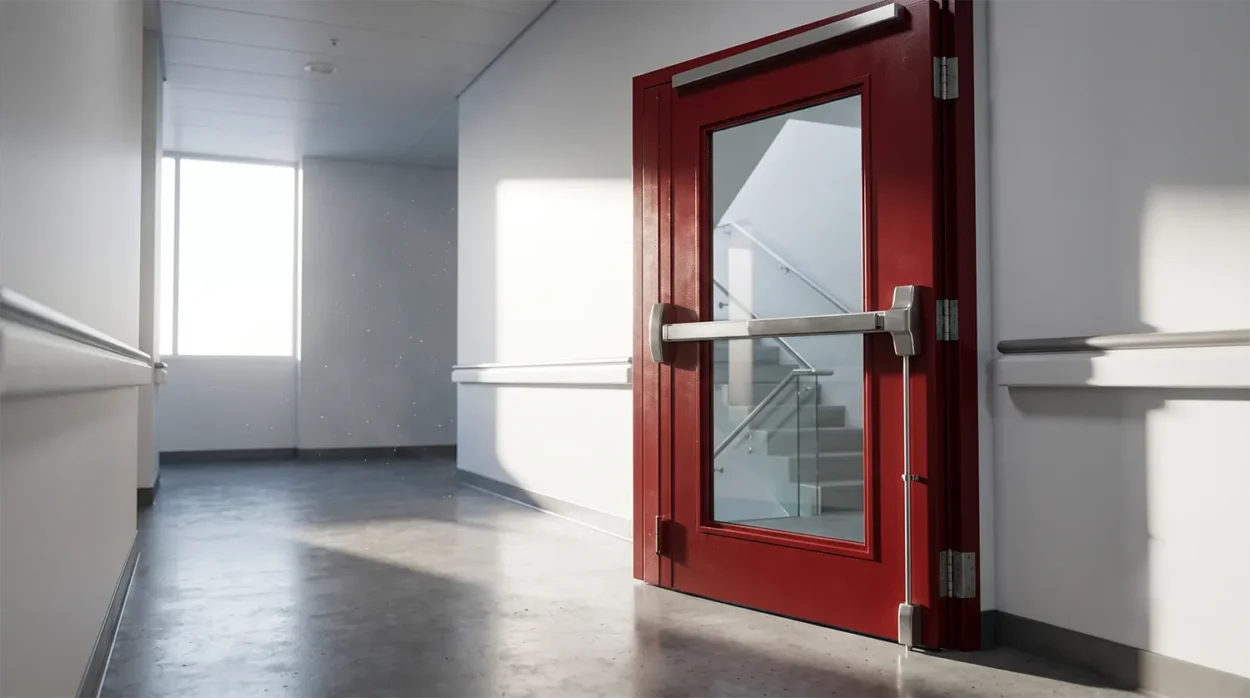
Installing non-certified doors can cause fatal safety failures and exposes developers to regulatory penalties or denied Fire No-Objection Certificates (NOC).
- IS 3614:2021 Standards: The Bureau of Indian Standards (BIS) requires that both leaf and frame be tested as a single assembly. KOR India’s BIS certification fire doors meet these criteria, providing verified fire safety performance.
- National Building Code (NBC 2016/2025): Part 4 (“Fire and Life Safety”) establishes clear compartmentation rules. All stair enclosures in commercial and industrial high-rises must feature NBC compliant doors with a minimum 120-minute rating.
- Traceability: KOR India labels every door leaf with its verified BIS license number, test report reference, and rating classification, ensuring verification during municipal fire inspections.
Why Architects and Builders Choose KOR India
As a specialized fire rated door manufacturer, KORINDIA Precision Private Limited combines South Korean design standards with domestic manufacturing expertise.
- Korean Production Standards: Engineered alongside Hallim Precision Co. Limited (South Korea), our fabrication lines use automated profiling, continuous seam welding, and accurate core binding.
- Strategic Manufacturing Location: Our Greater Noida plant in the Kasna Industrial Area provides fast delivery cycles across Delhi NCR, Uttar Pradesh, Haryana, and major industrial hubs in India.
- End-to-End Installation & Audits: Certified installation teams align frames, set intumescent perimeter seals, and maintain the 3 mm perimeter clearances required by fire testing criteria.
Frequently Asked Questions (FAQ)
An FD 60 fire door withstands standard furnace conditions for 60 minutes, typically used in office partitions and hotel corridors. An FD 120 door withstands exposure for two hours at temperatures exceeding 1050°C. The NBC requires 120-minute doors for escape stairwells, lift shafts, data centers, and hazardous industrial zones.
Yes. Under IS 3614:2021, vision panels are permitted if glazed with tested, clear fire-resistant glass (such as borosilicate or multi-layered intumescent laminates) that matches the fire rating of the door leaf.
Standard-sized, single-leaf steel fire doors in Delhi NCR generally range between ₹18,500 and ₹29,500 per unit, depending on the fire rating (FD 60 vs FD 120) and hardware configuration. Complete double-leaf emergency exits with panic hardware range from ₹34,000 to ₹54,000.
Even a certified fire door will fail in a fire if perimeter clearances exceed 3 mm or if the frame is not grouted with cement mortar or fire-grade sealant. KOR India’s factory-trained technicians install assemblies to preserve structural integrity, smoke containment, and fire resistance during an emergency.